
The same set of facts in Minneapolis and Saint Paul supports two irreconcilable stories at once: a federal indictment built on real evidence of coordinated obstruction, and a surveillance dragnet that reached unions, nonprofits, and clergy who did nothing but watch. Both are documented. Neither cancels the other out.
Key Points
- Federal prosecutors charged 15 people in June 2026 with conspiracy to impede or injure federal officers under 18 U.S.C. § 372, tied to Operation Metro Surge in the Twin Cities.
- DHS and FBI Director Kash Patel say the case rests on evidence that activists used Signal chats to track and identify ICE agents, not on ordinary protest speech.
- Separately, court filings and reporting allege DHS ran a broader “Protester Surveillance Policy” that swept in AFL-CIO, SEIU, DSA, and SURJ affiliates without individualized suspicion.
- Human Rights Watch documented two deaths, hundreds of detentions, and what it calls racial profiling during the same operation — a record DHS has not squarely rebutted.
- The dispute is unresolved because the underlying authorization memos, indictment text, and surveillance tasking orders remain largely outside the public record.
What Operation Metro Surge Actually Produced
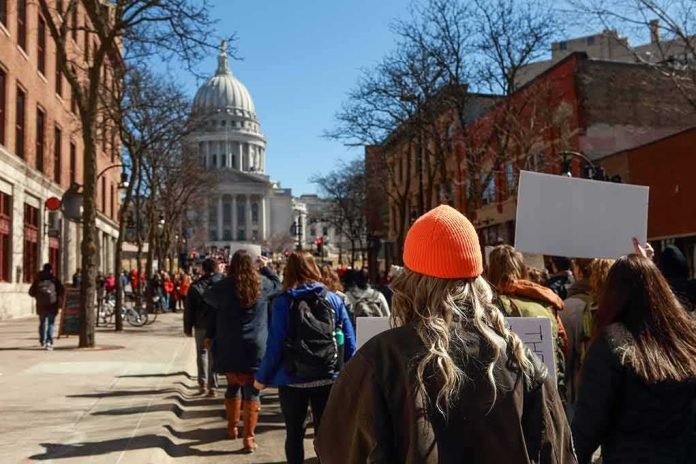
In December 2025, DHS launched Operation Metro Surge, an unusually large deployment of immigration enforcement agents into Minneapolis and Saint Paul that Minnesota’s own attorney general later described in federal court filings as “unprecedented” in scale. Seven months later, on June 16, 2026, U.S. Attorney Daniel Rosen and HSI Special Agent Michael McCarthy announced indictments against 15 defendants, alleging conspiracy to impede or injure federal officers — a serious federal charge that requires prosecutors to show coordinated intent, not merely presence at a protest.
The indictment’s factual core, as described by the Guardian and Courthouse News, alleges that defendants used encrypted Signal chats to track ICE vehicles and relay agents’ locations in something resembling a rapid-response network. FBI Director Kash Patel told Fox News the bureau opened its own inquiry into those chats specifically to determine whether the conduct crossed into doxxing or true threats against agents and their families. That is a materially different question than whether protest itself is lawful — it’s whether specific communications facilitated obstruction or endangerment, which is precisely what a conspiracy charge under § 372 requires prosecutors to prove.
The Broader Surveillance Record DHS Has Not Explained
Set against the indictment is a much larger and less legally tidy record. The Guardian reported that internal DHS documents disclosed through litigation show monitoring reaching the AFL-CIO, SEIU, the Minneapolis Federation of Educators, the Minnesota Association of Professional Employees, the DSA, and SURJ — organizations with no alleged connection to the conspiracy charges. A companion lawsuit covered by the Los Angeles Times alleges DHS operated under a secret “Protester Surveillance Policy” that collected records on Americans engaged in First Amendment activity and retained them for potential future use [4 in Side B / LA Times]. Notus reporting goes further, describing undercover agents attending community meetings, covertly recording conversations, and obtaining financial records “without any basis for suspecting criminal activity” — a description that, if accurate, describes exactly the kind of suspicionless collection courts have long held the government cannot conduct against protected speech and association.
Human Rights Watch’s June 2026 report, titled “A Manufactured Crisis,” adds a further and graver layer: it documents two deaths during the operation, hundreds of arrests and detentions, and what it characterizes as racial profiling and harassment that “terrorized” Minnesota communities. That report doesn’t resolve the surveillance question directly, but it establishes the atmosphere in which the surveillance occurred — one already marked by lethal outcomes and community fear, which makes any subsequent disclosure of covert monitoring land with more suspicion than it might in a calmer enforcement climate.
Why Both Claims Can Be True Simultaneously
This is the part that resists tidy resolution, and readers should resist anyone who offers one. A federal grand jury can find probable cause that a defined group of individuals conspired to obstruct federal officers, while the same operation’s intelligence-gathering apparatus reaches far beyond that defined group into lawful advocacy organizations. American surveillance law has never been especially good at drawing that line cleanly in practice, even though the legal standard is clear enough on paper: investigators need individualized, articulable suspicion tied to actual criminal conduct before they collect and retain records on people exercising First Amendment rights. DHS’s own past guidance, cited in a 2015 ACLU dispute over Federal Protective Service monitoring of advocacy groups, conceded the department “did not adequately distinguish between civil activist and violent extremist organizations” when it collected and disseminated data — a structural weakness with an documented history, not a novel accusation invented for this case.
DHS’s public defense has been categorical rather than granular. Assistant Secretary Tricia McLaughlin told CNN the department was “implementing proper and constitutional actions to maintain law and order while safeguarding our officers and the community from hazardous rioters” — a statement that answers the charge of illegitimacy but not the specific allegation that agents recorded license plates outside church events or sat outside a congressional town hall, as happened when an HSI agent in a vehicle with mismatched plates was found monitoring a Richfield event hosted by Rep. Ilhan Omar, prompting her public demand for an explanation. DHS has not, in the available record, offered a document-by-document accounting of why specific unions or nonprofits were swept into its files, and that silence is doing a great deal of interpretive work for critics.
"At another church event, federal agents recorded the license plates of people in attendance." https://t.co/K6H1w0PrmD
— EX POST!™ (@ExPostMedia) August 13, 2026
What the Public Record Still Cannot Settle
Neither side of this dispute has produced the documents that would actually settle it. No public source yet contains the unredacted tasking orders, minimization procedures, or legal authorizations behind the broader monitoring program, nor the full indictment text specifying exactly which acts by which defendants triggered the § 372 charges. Court proceedings in the criminal case, and parallel civil litigation over the alleged Protester Surveillance Policy, will eventually force at least some of that material into daylight through discovery — search-warrant affidavits, chat forensics, and internal DHS communications referencing the financial-record collection that Notus described. Until then, the honest assessment is that DHS has a real, charged criminal predicate for its Minnesota operation, and its critics have real, sourced evidence that the operation’s reach extended well past that predicate into constitutionally protected organizing. Treating either fact as the whole story misreads the record.
What this case demonstrates, more durably than any single Minnesota fact, is a structural feature of modern federal immigration enforcement: the tools built to investigate obstruction and violence are not self-limiting, and the same infrastructure that identifies a genuine conspiracy can just as easily catalog a union local’s meeting minutes. That tension predates this administration and will outlast this indictment. The Minnesota case is simply the clearest instance yet where a concrete prosecution and a documented overreach allegation sit side by side in the same operation, adjudicated by the same agency, defended with the same talking point.
Sources:
notus.org, npr.org, visaverge.com, nytimes.com, en.wikipedia.org, startribune.com, courthousenews.com