Spain’s Ceuta crisis mattered to Trump because it offered a ready-made visual argument: a border shock in Europe, amplified instantly into a warning about American political failure. The episode was real, the images were dramatic, and the White House treated them as proof that immigration is not just a policy issue but a test of state capacity.
Intro Header
- Trump used the Ceuta migrant surge as a direct warning about what could happen in the United States if Democrats return to power.
- Stephen Miller, JD Vance, and White House press staff echoed the same frame, turning a European border breach into domestic campaign material.
- The underlying Ceuta event was severe enough to trigger military deployment, emergency requests, and international coverage of deaths, disorder, and large-scale crossings.
- The strongest evidence supports the political messaging and the scale of the crisis; it does not prove the broader claim that Ceuta is a predictive model for the United States.
What Trump Was Responding To in Ceuta
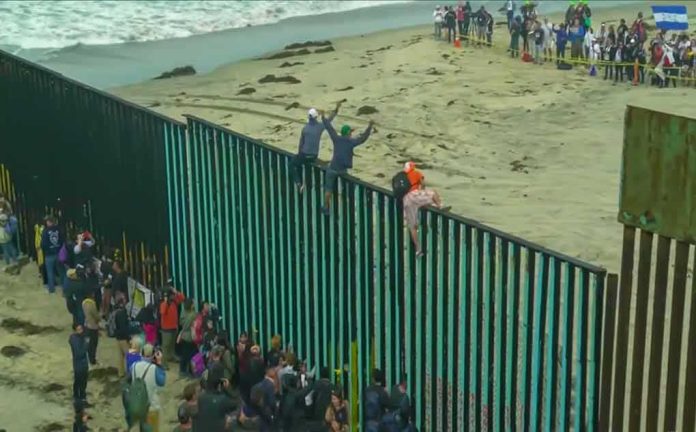
Reporting on the incident described a sudden and severe migration surge into Spain’s North African enclave of Ceuta, with accounts ranging from more than 2,000 crossings over ten days to roughly 60,000 people entering in a very short period, depending on the outlet and the slice of the crisis being described. Spanish authorities responded with military deployment, and local officials treated the situation as a humanitarian and administrative emergency rather than a routine border event. That matters, because the power of Trump’s statement rests on the fact that the footage was not abstract; it showed a border system visibly under strain.
Ceuta is not a distant metaphor in the European imagination. It is a small Spanish enclave on the Moroccan coast, a territorial pinch point where geography, asylum law, policing capacity, and migration pressure collide in a way that makes visible disorder easy to film and politically useful to weaponize. In that sense, Ceuta has a long history of functioning as a symbol larger than itself, and the 2026 episode fit that pattern cleanly: a real breach became a story about competence, sovereignty, and the fragility of borders.
How Trump and His Allies Framed the Event
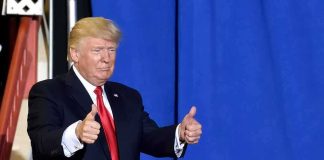
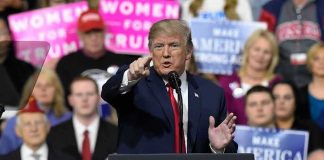
Trump’s line was blunt and theatrical. He told Fox News, “It’s terrible. Remember that picture. That’s going to be us in three years if the wrong side gets in,” and he tied the warning directly to Democrats winning future elections. That was not a neutral observation about European migration policy; it was a domestic political forecast, built on the premise that a foreign border crisis can be read as a preview of America under the wrong government. The move is classic Trump: take a vivid image, compress it into a slogan, and convert the image into partisan prophecy.
Stephen Miller sharpened the same message on social media, arguing that Democrats had already done this to America under Biden and would do it again at greater scale if given power. JD Vance added a broader civilizational layer, calling the Ceuta footage evidence of “radical left-wing globalist policies that have enabled the Invasion of the West.” The White House press office then translated the rhetoric into official condemnation, accusing Spain’s left-wing government of “far-left, globalist policies, including enabling mass migration,” and warning Spain to reverse course or risk “their own demise.” Taken together, the messaging was coordinated, fast-moving, and unmistakably political.
Why the Ceuta Image Is So Effective Politically
The Ceuta footage works as political persuasion because it condenses several anxieties into one frame. It suggests loss of control, mass movement, visual disorder, and government incapacity all at once; it does so in a form that social media can circulate faster than any rebuttal can settle. Once that image enters partisan circulation, the question ceases to be only what happened in Spain and becomes what the viewer believes about borders, elites, and national decline. That is why Ceuta is more potent as a symbol than as a policy case study.
The rhetorical leap is also obvious. Trump and his allies are not merely saying that Spain had a crisis. They are saying that permissive immigration politics, especially on the left, produce civilizational unraveling, and that the United States is one election away from the same fate. The evidence in the supplied reporting does not establish that chain of causation. It shows political actors asserting it, not proving it. The distinction is important. A border emergency can be real without serving as a clean model for another country’s future.
What the Reporting Does and Does Not Prove
The factual core of the story is strong: there was a major migrant surge, it drew emergency response, and leading U.S. officials used it immediately as political ammunition. What the reporting does not supply is a rigorous comparison between Ceuta and the United States. The sources do not give demographic equivalence, comparable border geometry, or a policy analysis showing that Spanish conditions are predictive of American ones. That is why the warning reads as forceful rhetoric rather than as demonstrated forecasting.
There is also a scale problem in the reporting that deserves attention. Some outlets emphasized a huge daily inflow; others highlighted that many migrants returned voluntarily the same day, which complicates any claim that the episode represented a permanent collapse of order. In other words, the crisis was serious, but its political meaning is elastic. One can acknowledge disorder, deaths, and emergency measures without accepting the harder ideological claim that the event settles the immigration debate in favor of one side.
NEW: President Trump reacts to the massive migrant surge overwhelming Ceuta, Spain, warning it could happen in America.
"It's terrible. Remember that picture. That's going to be us in three years if the wrong side gets in," Trump tells Fox News' @JacquiHeinrich, referring to…
— Q RIGHT SCOPE (@Qrightscopee) July 31, 2026
Why This Matters Beyond One Border
Ceuta is a case study in how migration crises are used in modern politics: the event itself may be local, but the image is transnational and the interpretation is domestic. Trump, Miller, Vance, and White House staff treated the Spanish enclave not as a foreign headline but as a warning sign for American voters, especially on the eve of election-season argument. That is the strategic lesson here. Border episodes now travel as symbols first and policy evidence second, and the side that controls the symbol often controls the first impression.
For readers trying to separate signal from spin, the correct takeaway is narrower than the rhetoric suggests. Ceuta showed how quickly a border can be overwhelmed and how quickly political actors will turn that fact into an ideological weapon. It does not, by itself, prove that the United States is destined to repeat the same outcome. It proves something more immediate and more durable: in immigration politics, a dramatic image can become a national argument before anyone has time to inspect the mechanism underneath it.
Sources:
insiderpaper.com, washingtontimes.com, facebook.com, news18.com, yahoo.com, english.alarabiya.net, youtube.com, foxnews.com, aa.com.tr, bbc.com