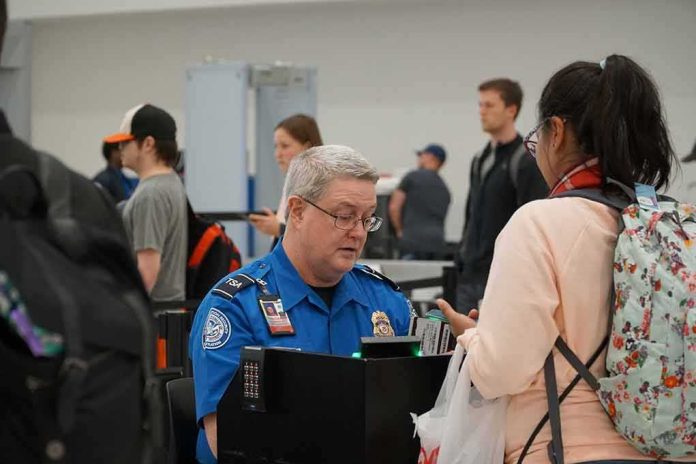
ICE’s airport arrests are not a marginal tactic; they are what immigration enforcement looks like when passenger data, interagency matching, and a controlled physical setting are combined into a single pipeline. The significance is not just that arrests are happening at airports, but that a system originally built for preflight screening is now being used to generate civil immigration leads at scale.
Intro Header
- The practice is operationally real, not theoretical: reporting based on internal ICE data says TSA shared records on more than 31,000 travelers and those leads helped produce more than 800 arrests.
- The legal and technical backbone already exists in TSA’s Secure Flight program, which is designed to vet passenger information before travel.
- A May 2025 TSA-ICE agreement formalized broader information sharing, turning an informal channel into a more structured enforcement tool.
- The strongest public objection is not that the arrests are fake, but that the criteria, safeguards, and full agreement text remain only partially disclosed.
How the Airport Arrest Pipeline Works
The mechanics are straightforward once stripped of bureaucratic language. TSA collects and screens passenger information through Secure Flight, a long-standing passenger vetting system; ICE then receives leads that identify noncitizen travelers suspected of civil immigration violations such as visa overstays or final removal orders. Reporting based on Reuters-referenced internal ICE data says that process generated information on more than 31,000 travelers and led to more than 800 arrests through February 2026. That is a meaningful enforcement stream, not an isolated handful of cases.
Airports are especially useful for this kind of action because they are controlled environments. Former ICE acting director John Sandweg told CNN that an airport simplifies an arrest because agents know where the person is, can act before the traveler disappears into the broader population, and face less tactical risk because no one is armed in the same way they might be in a street encounter. That matters operationally. If an agency wants to convert paper records into custody, a departure gate or check-in counter is a far easier place to do it than a home, workplace, or neighborhood stop.
Why This Is Growing Now
The timing is as important as the mechanism. Reporting says the arrangement intensified in 2025, when TSA and ICE signed a formal information-sharing agreement in May, expanding a relationship that DHS sources described as longstanding cooperation rather than a brand-new invention. That distinction matters less politically than operationally: once a data path exists, agencies do not need a fresh statute each time they find a new use for it. They need internal permission, access, and enough institutional comfort to keep the matching process running.
This is classic function creep. A system designed for counterterrorism screening becomes, by degrees, a civil immigration enforcement instrument. Secure Flight was built to vet passengers against security concerns; using it to identify people with deportation orders or overstayed visas is a different policy purpose, even if both live under the same departmental umbrella. That is why the issue generates such intense scrutiny from privacy advocates. The public sees a transportation-security system; enforcement agencies see a ready-made data warehouse.
What the Public Record Does and Does Not Show
The strongest facts are the existence of the data sharing and the resulting arrests. The weaker part of the public record is the one that would be needed to assess proportionality and legality with precision. The reporting provided here does not include the full text of the May 2025 TSA-ICE agreement, the implementing guidance, or the ICE field instructions that determine when a TSA lead becomes an arrest. Without those materials, the public can see the outcome but not the rulebook.
That gap is not trivial. Reuters-based reporting says TSA information led to more than 800 arrests, but it also could not determine how many of those arrests occurred inside airport facilities as opposed to just after travel or in related encounters. In other words, “airport arrests” is a useful shorthand, but not always a precise physical category. The same reporting also leaves open how often leads were ignored, how many were false matches, and what standards ICE used to sort high-confidence targets from lower-confidence ones. Those are the questions that separate a broad surveillance practice from a narrowly tailored enforcement tool.
A heavily-redacted agreement between the TSA and ICE was released on Tuesday, confirming the two agencies share information, but leaving unclear exactly what data is being exchanged as ICE has ramped up arrests at airports. https://t.co/4U78ZB9mFP
— Next with Kyle Clark (@nexton9news) July 30, 2026
Who Is Being Targeted
Reporting suggests the arrests are aimed largely at people the federal government already considers removable: visa overstayers, people with final removal orders, and others flagged for civil immigration violations. CBS reporting said TSA has been sharing information on noncitizen travelers suspected of those violations, including people without criminal records. That is consistent with the broader ICE enforcement push documented elsewhere in 2026, when agency pressure to increase arrest numbers clearly intensified the appetite for ready-made leads.
At the same time, some reporting describes cases that complicate the easy narrative of “clear-cut enforcement.” NewsNation and other outlets have highlighted travelers who were reportedly detained while carrying work authorization or parole-related documents, and attorneys in several cases argued that the people arrested had valid papers or open applications. Those reports do not by themselves prove misclassification, but they do explain why the practice has drawn so much attention. When a system built to match identities and statuses reaches people who say they were lawful travelers, the public controversy moves quickly from enforcement to credibility.
Why Airports Are Becoming an Enforcement Frontier
The airport setting gives ICE several advantages at once. It concentrates people at predictable times, limits the need for prolonged searches, and reduces the chance of confrontation compared with arrests in homes or on the street. It also exploits the ordinary act of travel, which means the enforcement moment can arrive with little warning and with little public visibility. That combination makes airports uniquely efficient for immigration enforcement, even if the tactic looks jarring to travelers who thought they were simply boarding a plane.
There is a larger policy logic behind that efficiency. ICE already maintains broad arrest, detention, and removal infrastructure, and its own statistics system tracks enforcement activity continuously. Airport enforcement fits that machinery because it turns a shared database into a case-generation tool. Once an agency is built to process removability, any place where identity can be verified and a person can be located becomes a potential arrest point. Airports are simply the cleanest version of that logic.
The Real Dispute: Scope, Safeguards, and Mission Drift
The central dispute is not whether ICE is making airport arrests; it is whether the practice is narrowly justified or an overbroad reuse of security data. Supporters can point to the operational reality: the leads are real, the arrests are real, and the targets described in the reporting are generally people already believed to be removable. Critics focus on the asymmetry of information. The agencies have the data, the algorithms or matching rules, and the operational records; the public gets fragments, summaries, and a memo excerpt, but not the full architecture.
That asymmetry is why this issue is likely to remain contentious. The more that passenger data is used for immigration enforcement, the more the original Secure Flight purpose recedes from view. What began as a preflight screening system increasingly functions as a live enforcement feed. The result is not just more arrests. It is a new normal in which the travel experience itself becomes a point of immigration exposure, and that shift will keep drawing pressure for disclosure, oversight, and, if the records eventually show overreach, possible legal challenge.
Sources:
cbsnews.com, deportationdata.org, theguardian.com, youtube.com, newsmax.com, nytimes.com, tracreports.org, jeelani-law.com, instagram.com