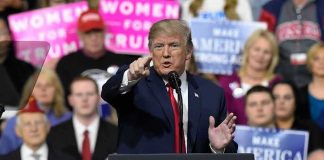
The real fight here is not over rhetoric; it is over who gets to define success in a war that is still ongoing, still expensive, and still politically unresolved. Pete Hegseth’s defense rests on a classic wartime claim — that the mission is to stop Iran from obtaining a nuclear weapon — while Senator Gary Peters attacks the strategy, the legality, and the funding logic behind it.
Key Points
- Hegseth’s core argument is that the mission is necessary and that additional war funding is operationally justified.
- Peters’ criticism is not a blanket rejection of pressure on Iran; it is a challenge to the administration’s strategy, authorization, and public consistency.
- The argument is also a familiar Washington struggle over the power of the purse, with Congress trying to shape war policy through funding leverage.
- The sharpest dispute is evidentiary: whether the administration has a coherent path to its stated objective, and whether the requested money matches that path.
What This Argument Is Really About
Hegseth and Peters were not merely trading insults. They were staging an old and consequential American argument about war powers: when the executive says the mission is urgent and troops need support, and when Congress says urgency is not a substitute for authorization, strategy, or proof of success. The immediate spark was Peters calling Hegseth a “failure” over the Iran war, but the deeper issue was the administration’s request for additional funding to sustain operations.
Hegseth’s side of the case is straightforward. He presents the mission as preventing Iran from obtaining a nuclear weapon and treats the funding request as the price of carrying that mission forward. That is a durable defense in Washington because it ties money to force protection and mission continuity, the two most politically resilient justifications for military spending. The difficulty is that this kind of argument can be persuasive even when the strategic end state remains blurry, which is exactly where Peters pressed hardest.
Peters’ Critique Is Broader Than a Sound Bite
Peters is often quoted for the sharpness of his line, but the substance behind it is more disciplined than the shouting match suggests. In his Senate statement, he argued that the administration should come to Congress for authorization before continuing unilateral military operations, and he supported a War Powers Act resolution to block further action without approval. That is not the posture of someone opposing pressure on Iran as a matter of principle. It is the posture of a senator demanding legal process, congressional buy-in, and an articulated strategy before more American power and money are committed.
He also made a narrower, strategically important point: the central objective — dealing with Iran’s nuclear material and nuclear threat — was still unresolved. CBS’s transcript summary of the exchange says Peters challenged the administration’s claim of success by arguing that the primary war objective remained unmet, and he called the funding request a “blank check” in the absence of a winning strategy. That matters because it moves the criticism from partisan condemnation into a concrete policy objection: if the objective is undefined or incomplete, then the request for more money is not just large, it is premature.
The Funding Fight Is the Real Pressure Point
The funding numbers are what make this dispute more than a procedural quarrel. Hegseth told senators that the war had already cost an estimated $37.5 billion, and contemporaneous reporting described a broader supplemental request reaching tens of billions more. Other reporting in the research package places the requested number even higher in earlier stages of the conflict, with one account describing a potential $200 billion request and noting that the figure could change. Those numbers are not just accounting trivia; they are the mechanism by which Congress can force clarity. In American war powers politics, money is often the only lever Congress can actually pull.
That is why Peters’ “blank check” language lands. The phrase captures a familiar congressional fear: once a military campaign begins, supplemental funding becomes a way to normalize a conflict before lawmakers have answered the hard questions about endpoint, legality, and tradeoffs. The research package also notes that Hegseth defended the request by framing criticism as undercutting troops and readiness, a rhetorical move that often shifts the debate from strategy to patriotism. It is effective politics. It is not the same thing as strategic clarity.
The War Powers Issue Is Not Decorative
There is a reason Peters kept returning to Congress’s role. The historical record is clear that Congress has long used funding cutoffs and restrictions to influence military operations abroad, and CRS materials in the package describe that as one of the legislature’s most effective tools when it disagrees with an overseas deployment. That institutional backdrop matters here because Peters is not simply objecting to the size of the bill. He is asserting that the executive branch cannot keep enlarging the war while treating legislative approval as optional.
The broader legal tradition reinforces that instinct. The materials in the research package point to the constitutional principle, familiar from Youngstown, that presidential power is strongest when tied to congressional authorization and weakest when it operates alone. Peters’ argument sits squarely inside that tradition: if the administration wants the country to pay for an expanding war, it must explain not only what the money buys, but who authorized the underlying operation and why the country should believe the operation is succeeding.
NEW: A fuming Dem Senator Gary Peters starts shouting after Secretary of War Pete Hegseth fired back at him over the war in Iran.
Peters: "When will you show leadership?"
Hegseth: "Why don't you show some leadership and stand up to your fellow Democrats who won't fund the… pic.twitter.com/1SNjzlNdgW
— Collin Rugg (@CollinRugg) July 21, 2026
Why the Exchange Became So Heated
Sharp exchanges like this become combustible because each side is speaking to a different audience and using a different standard of proof. Hegseth is speaking as an executive official whose burden is to defend the mission, preserve funding, and avoid signaling weakness. Peters is speaking as a senator whose burden is to expose strategic drift, demand legal justification, and force the administration to defend itself in public. In that setting, “failure” is not just an insult; it is a summary judgment on the administration’s narrative.
But the research package also makes one thing plain: Peters’ criticism is not refuted simply because the exchange was loud. The sources provided do not show a public intelligence assessment proving the mission was complete, nor do they contain a line-item budget audit disproving the funding request. What they do show is an administration asking for substantial new money while defending a war whose endpoint remains contested and whose legal footing remains disputed. That is why the argument is durable. It is not about tone; it is about whether the United States is being asked to finance an open-ended war before Congress has been shown a convincing theory of victory.
What This Means Going Forward
Seen in historical perspective, this clash is likely to recur whenever a White House frames an overseas campaign as necessary and Congress senses that necessity is being used to outrun oversight. The pattern is old: the executive emphasizes urgency, troops, and deterrence; lawmakers emphasize authorization, cost, and the absence of a coherent end state. In this case, Peters has the stronger institutional critique because he grounds it in congressional prerogative and unresolved strategy, while Hegseth’s case depends heavily on confidence in an administration that has not fully supplied the public record needed to test its claims.
That does not mean the administration’s mission statement is meaningless. Preventing a hostile state from acquiring nuclear weapons is one of the most durable justifications for military action in modern U.S. policy. But a mission statement is not a war plan, and a war plan is not proof that more money will produce success. The contest between Hegseth and Peters is ultimately about that gap. The louder the exchange becomes, the more important the gap is to notice.
Sources:
youtube.com, newsweek.com, globalnews.ca, peters.senate.gov, thehill.com, ajcongress.org, cbsnews.com, economictimes.indiatimes.com