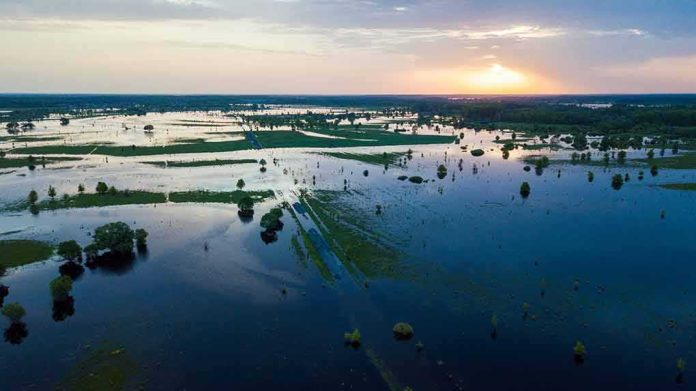
South-central Texas woke up on July 16, 2026, to walls of water swallowing highways, sweeping away vehicles, and killing people in their sleep — and the region had seen this nightmare before, just one year earlier.
Story Snapshot
- The National Weather Service issued a rare Flash Flood Emergency for Kerr and Uvalde counties on July 16, 2026 — its highest threat level, reserved for imminent danger to life.
- Storms dumped up to 20 inches of rain across parts of south-central Texas, closing all roads in Uvalde and submerging every major highway.
- At least two people died — a man swept away in an RV near Comfort and a woman killed while driving in Uvalde.
- More than 1,300 rescue personnel were deployed, with at least 70 people pulled from floodwaters as of Thursday morning.
Twenty Inches of Rain and Nowhere to Go
The storms did not arrive quietly. Starting around midnight and intensifying by 6 a.m., thunderstorms dropped between 10 and 20 inches of rain across Uvalde County and surrounding Hill Country in just hours. Every road in Uvalde closed. Every highway went underwater. The National Weather Service (NWS) issued a Flash Flood Emergency — not a watch, not a warning, but an emergency — a designation that signals catastrophic, life-threatening flooding already in progress. For Kerr and Uvalde counties, that declaration came before sunrise.
The NWS Flash Flood Emergency is rare. It means forecasters are not guessing about what might happen. They are telling you people are about to die. In this case, they were right. A man near Comfort was swept away inside an RV. A woman in Uvalde was killed when floodwaters overtook her vehicle. These are the two deaths confirmed as of Thursday. Rescue teams were still working. The number could rise.
Why the Texas Hill Country Turns Rain Into a Death Trap
The Hill Country’s geology makes it one of the most flood-dangerous regions in the United States. The soil sits on top of hard limestone. When it dries out between storms, it stops absorbing water. Rain hits the ground and runs straight into creeks and rivers instead of soaking in. Add steep terrain, and those rivers can rise more than 26 feet in under an hour. That is not a slow-moving flood. That is a wall of water. Driving into it — even in a large vehicle — can be fatal in seconds.
This is not a new discovery. The same forces killed at least 119 people in Kerr County during the July 2025 floods, including 27 girls and counselors at Camp Mystic. Scientists called that event a worst-case scenario — a perfect collision of dry soil, extreme rainfall rates of 2 to 4 inches per hour, and terrain that funnels every drop directly into rivers. In July 2026, those same conditions returned to the same region, hitting communities that had barely finished grieving.
Over 1,300 Responders Deployed Across the Region
Texas Governor Greg Abbott confirmed Thursday morning that more than 1,300 personnel were engaged in flood response and rescue operations across south-central Texas. At least 70 people had been pulled from floodwaters by the time he spoke. In Uvalde County alone, more than 75 people had already been rescued in the days leading up to July 16, and mandatory evacuation orders were in place before the worst of the rain arrived. The scale of the response reflects how seriously officials treated the threat — and how fast conditions deteriorated despite their efforts.
A larger FLASH FLOOD EMERGENCY has been issued across southeastern Crockett County in Texas, where between 3.5 to 9 inches of rain have fallen, with 1-2 more inches possible within the warned area. Flash flooding is already ongoing.
If you are in this warning, move to higher… pic.twitter.com/FZXn0Paoa7
— Max Velocity (@MaxVelocityWX) July 17, 2026
Questions about warning systems and siren functionality have surfaced in the aftermath, as they did after the 2025 disaster. Some residents reported hearing no sirens before evacuation orders were issued. Local emergency management has not publicly addressed whether warning systems were operational. These are fair questions that deserve straight answers. A region that has now suffered catastrophic flooding in back-to-back summers has earned the right to know whether every available tool was used. Accountability after a disaster is not an attack on first responders — it is how communities get better at saving lives before the next storm arrives.
A Pattern That Texas Has the Power to Break
Texas lawmakers had a chance to strengthen flood protections before this storm hit. They did not take it. Multiple flood protection bills failed in the state legislature in May 2026. That failure looks worse today than it did in the spring. The Hill Country’s flood risk is not a secret. It is documented, studied, and tragically confirmed year after year. Choosing not to invest in better warning infrastructure, flood mitigation, and community preparedness is a policy decision — and policy decisions have consequences that show up in the form of body counts.
The good news, if any exists here, is that the emergency response on July 16 was fast and large. Rescuers pulled dozens of people from floodwaters. The NWS issued its highest-level alert. Evacuations were ordered. Those actions saved lives. But saving lives in the middle of a disaster and preventing deaths before one strikes are two different things. Texas has the data, the history, and the resources to do both. The only missing ingredient has been the political will to act before the water rises.
Sources:
youtube.com, ialert.com, facebook.com, abcnews.com, fox7austin.com