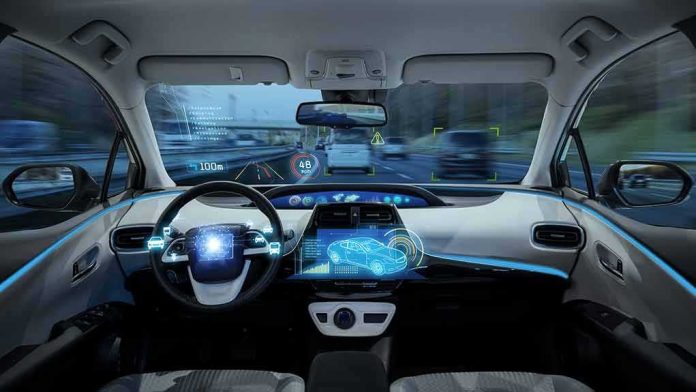
Europe just turned every brand-new car into a silent backseat cop, and the fight now is over whether that camera saves lives or quietly erodes freedom.
Story Snapshot
- From July 7, 2026, every new EU car and van must have a driver-facing camera watching your eyes and head.
- The system is built to spot distraction and fatigue in real time and blast you with alerts if you look away too long.
- Lawmakers promise no facial recognition and no data leaving the car, but they left big gaps in audits and enforcement.
- Conservatives and privacy advocates see a “safety” rule that could easily slide into mass surveillance and data monetization.
Europe’s new cars now come with a built-in watcher
Starting July 7, 2026, every newly registered passenger car and van in the European Union must include an Advanced Driver Distraction Warning system built around an interior camera aimed at the driver’s face. This camera tracks your gaze direction and head movements while you drive. If you look away from the road for more than six seconds at city speeds or 3.5 seconds on the highway, the car must warn you with lights, sounds, or seat vibration until you look back.
The rule is part of the second phase of the European Union’s General Safety Regulation, the same push that made automatic emergency braking and speed assistance standard. The stated goal is simple and hard to argue with: cut crashes caused by distraction and drowsy driving, which regulators say make up a big slice of serious accidents. In practice, it means every new European car now ships with a camera that never stops watching the person behind the wheel.
How the attention camera works when you are on the road
The system relies on an infrared camera inside the cabin, usually mounted on the dashboard and pointed at your eyes and upper body. Software analyzes where your eyes are looking, how your head is angled, and how often you blink, to judge whether you are paying attention or nodding off. Above 20 kilometers per hour, the system must be “always on.” You cannot legally switch it off, and it must trigger alerts when distraction crosses its time limit.
At speeds between 20 and 50 kilometers per hour, the camera can allow up to six seconds of looking at your phone, your lap, or the center console before sounding the alarm. Above 50, that limit drops to 3.5 seconds. The car escalates warnings if you ignore them, using screen messages, beeps, or haptic feedback, until you turn your eyes back to the road. Some systems also flag obvious drowsiness signs such as drooping eyelids or a sagging head.
Privacy promises: no face ID and no cloud uploads
European lawmakers know how this looks, so the technical rulebook includes strong privacy language. The advanced distraction warning system must operate without biometric identification or facial recognition of any occupant. In plain terms, the software is supposed to answer “where are the eyes pointed?” not “who is this person?” The regulation also says images must be processed inside the vehicle’s own computers and not stored or sent to outside servers under normal operation.
Supporters claim this “closed loop” design makes the system more like an automatic seatbelt reminder than a spy camera. They point to past safety rules such as crash data recorders, which stirred anger at first but later became normal as drivers saw benefits in accident claims and defect investigations. On paper, the rules line up with common sense conservative views about targeted safety: the government sets clear limits, bans ID tracking, and keeps data local.
Where the fine print gets fuzzy and critics see real risk
The trouble starts when you look for hard limits and independent checks. The regulation says data must be deleted “right after it’s processed,” but it does not define a clear time window or a technical standard for that deletion. It also does not create an EU-wide audit agency to verify that automakers truly keep data inside the car and avoid biometric tricks. Compliance rests on manufacturer claims, not ongoing, public third-party inspections.
EU is now mandating every car come equipped with an interior-facing camera as part of an “advanced driver distraction warning system” that can monitor when drivers are distracted#Europe #EU #surveillance #privacy #automotive #auto #cars #transportationhttps://t.co/0UPNztMNB6
— Gtbarry (@gtbarry) July 16, 2026
Legal analysis notes another gap: there are no specific penalties spelled out if a company secretly transmits attention data or uses biometric identification anyway. That might sound minor until you remember recent scandals where car makers quietly sold driving behavior to insurance brokers, helping them adjust rates based on how you drive. From a conservative, rule-of-law view, a mandate without sharp enforcement teeth and outside audits invites mission creep and corporate abuse, even if the official text looks clean.
Safety gains, false alarms, and the American conservative lens
There is a real safety case. Regulators cite research that driver inattention plays a role in a large share of serious accidents, and that faster alerts can prevent some crashes before they happen. Fleet experience in trucking shows inward-facing cameras can reduce risky habits, but it also shows how clumsy systems can punish normal behavior. One driver described an artificial intelligence system flagging him as “distracted” simply for eating watermelon, adding unfair safety points to his record.
That kind of false alarm matters when governments tie safety scores to licenses, jobs, or insurance rates. A conservative, liberty-first view sees a pattern: once a camera and a scoring system exist, pressure grows to extend them beyond basic alerts. Activists already describe the EU rule as “dystopian surveillance” and “anti-freedom,” warning that manufacturers could misuse or sell driver information despite current bans. Without strict audits, short retention limits, and clear punishments, those warnings align with both history and common sense skepticism.
Is this about safety today or control tomorrow?
For now, no one has produced firm forensic proof that these mandated systems in Europe are transmitting live video feeds or running hidden facial recognition. The cameras focus on geometry, not identity, and the law on paper forbids broader surveillance, marketing profiling, or law enforcement access. If regulators publish detailed audits, accident statistics, and data-handling reports that back those promises, many fears may fade, as they did with earlier safety tech.
But the core tension will not go away: a car that can always tell when your eyes leave the road can also tell when you look at a protest sign, a church, or a political ad. The hardware is the same. For readers who value limited government and strong personal privacy, the smart stance is clear. Support real road safety and better driver awareness, but demand clear deletion rules, tough audits, and hard penalties before accepting a law that points a camera at every driver’s face and trusts future bureaucrats and corporations never to cross the line.
Sources:
reason.com, modernity.news, forbes.com, repairerdrivennews.com, faq.com.tw, newsbreak.com, neonode.com, thenextweb.com, youtube.com, cryptopolitan.com, autonocion.com, facebook.com, cybernews.com, instagram.com, reddit.com