

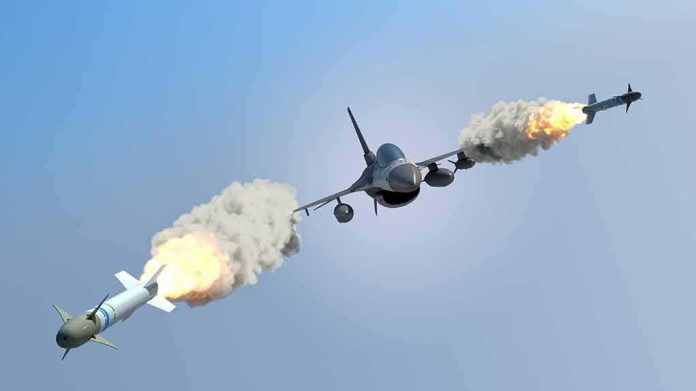
The claim that a Russian Su-35S shot down a Ukrainian MiG-29 from 190 kilometers away illustrates both the real technological leap of modern long-range air-to-air missiles and the information fog that makes individual “record kills” almost impossible to verify in a near‑peer war.
Key Points
- Ukraine has officially confirmed the loss of a MiG-29 over the Poltava region with the pilot surviving, but has not confirmed how it was brought down.
- Russian and pro-Russian outlets promote an air‑to‑air kill at roughly 190 km by an Su‑35S using an R‑37M missile, yet Moscow’s Ministry of Defense has not formally endorsed the specific claim.
- The R‑37M’s design and published performance make such a long-range engagement technically plausible under favorable launch conditions.
- Key details of the event—exact location, weapon, and engagement type—remain uncorroborated by independent telemetry, satellite data, or aligned accounts from both sides.
What We Actually Know About the MiG‑29 Loss
The only fully documented element in this story is the loss of a Ukrainian MiG‑29, not the manner of its destruction. On June 27, the Ukrainian Air Force reported losing contact with a MiG‑29 during a combat mission in the Poltava region; the pilot ejected, communicated with search-and-rescue teams, and was evacuated to medical care. Ukraine’s official communiqué, carried by United24Media, stated that the “circumstances and cause of the incident remain under investigation,” explicitly avoiding any attribution to enemy action or specifying whether the loss was due to an air‑to‑air missile, a surface‑to‑air weapon, or mechanical failure.
In parallel, Russian media circulated video claiming the destruction of two Ukrainian MiG‑29s at an airfield in the Mykolaiv region on roughly the same date. Open viewing of that footage, as summarized by independent channels, shows what appears to be a single jet being hit, not two separate kills, and the location asserted in Russian reports (Mykolaiv) does not match the Ukrainian account (Poltava). The combination of a location mismatch and an aircraft-count discrepancy is a classic warning sign: the underlying incident is real—a MiG‑29 has been lost—but individual narrative details are being shaped for information effect.
Inside the Russian Claim: A 190‑Kilometer Su‑35S Kill
Russian-aligned commentary frames the event as a doctrinal milestone. In that version, a Russian Aerospace Forces Su‑35S, flying in Russian-controlled airspace near Belgorod, detected a Ukrainian MiG‑29 over Poltava and launched an R‑37M air‑to‑air missile from approximately 190 km away. The missile, traveling at hypersonic speed, is said to have intercepted the Ukrainian fighter without the Russian pilot ever crossing into Ukrainian airspace. Pro-Russian outlets and some defense commentators brand this the longest‑range fighter‑vs‑fighter kill on record, a showcase of Russian aerospace dominance and a vindication of years of investment in the R‑37M program.
This narrative leans heavily on several true technical points. The R‑37M, NATO designation AA‑13 “Axehead”, is a very long range air‑to‑air missile originally developed for the MiG‑31BM interceptor but now integrated on the Su‑35S. It combines an inertial navigation system with mid‑course data‑link updates and an active radar seeker in the terminal phase, giving it a fire‑and‑update profile: the launching aircraft can fire at a distant target, rely on offboard sensors or its own radar for mid‑course updates, and allow the missile to acquire independently in the endgame.
Open technical sources describe the R‑37M’s maximum kinematic reach in the 300–400 km class when launched at high altitude and speed against non‑maneuvering or poorly aware targets, with speeds advertised up to roughly Mach 6. A U.S. Army ODIN profile notes that effective range is strongly flight‑profile dependent, from about 150 km in direct shots to nearly 400 km under optimal conditions, such as a high‑altitude, high‑speed launch against a target that does not maneuver hard or that flies on a predictable path. On paper, therefore, a 190 km engagement is not extraordinary for this missile family; it sits well inside the top end of the envelope that Russian and Western technical references attribute to the R‑37M.
Where the Evidence Falls Short
Technical plausibility is not the same as factual confirmation. When we test the 190 km kill story against the available evidence, several gaps and contradictions appear.
First, Russia’s own Ministry of Defense has not officially confirmed this specific beyond‑visual‑range engagement. The Ministry has publicly claimed the destruction of Ukrainian MiG‑29s at airfields and in other contexts, but the record‑setting 190 km air‑to‑air claim appears mainly in semi‑official media, commentators, and social channels rather than in formal MoD battle reports. For an event that would serve as a powerful proof‑point for Russian missile exports and doctrine, that silence is notable.
Second, the geospatial and numeric inconsistencies weaken confidence. Ukraine’s confirmed loss is in Poltava, in flight, with one pilot ejecting and surviving. Russian video and some media narratives speak of two MiG‑29s destroyed in Mykolaiv, and the imagery most widely circulated shows only one aircraft destroyed, apparently on or near the ground. Reconciling “two jets at an airfield in Mykolaiv” with “one jet on a combat mission over Poltava” requires a chain of assumptions that the available imagery and statements do not support.
Third, the open‑source intelligence that supposedly “confirms” the 190 km geometry is, at least in publicly accessible form, interpretive rather than definitive. Some outlets reference OSINT analysts who have mapped a plausible missile trajectory from Russian airspace to Poltava using basic range rings and known R‑37M performance figures. That kind of modeling can show that an engagement is possible, but without raw radar tracks, satellite infrared signatures, or authenticated telemetry, it cannot prove that a given missile was fired, from a specific aircraft, at a specific time and target.
Finally, there is the broader statistical context. A major survey of air‑to‑air combat claims over the last five decades found that extreme‑range engagements—beyond about 150 km—constitute a tiny fraction of confirmed kills, and that highly specific range claims by belligerents are often exaggerated, misattributed, or simply wrong when cross‑checked against independent data. In the Russia‑Ukraine war, both sides routinely announce shoot‑downs and “unique” long‑range feats, but independent confirmation—via neutral sensors or declassified logs—remains rare. Against that backdrop, treating a single, uncorroborated 190 km claim as established fact would be a substantial evidentiary leap.
How R‑37M and Su‑35S Change the Geometry of the War, With or Without This Kill
Even if the specific 190 km engagement remains unproven, the underlying capability shift it points to is real. Air‑to‑air missiles are broadly grouped into short‑range, within‑visual‑range weapons optimized for agility, and beyond‑visual‑range (BVR) weapons that emphasize reach, energy, and seeker performance. The R‑37M sits at the extreme of the BVR spectrum: it is designed to hold high‑value airborne assets—AWACS, tankers, and bombers—at risk far from the front line, and it can also threaten fighters that lack equivalent‑range weapons.
On a platform like the Su‑35S, which carries a powerful radar and can leverage Russia’s integrated air defense network, the missile changes Ukrainian pilots’ risk calculus. A MiG‑29 operating anywhere near the forward edge of battle may find itself inside a potential R‑37M engagement envelope long before it can get close enough to employ its own medium‑range missiles effectively. Western analyses of the conflict note that Russia has failed to achieve theater‑wide air superiority over Ukraine, but that it has carved out localized air‑denial zones using layered ground‑based air defenses and long‑range missiles launched from standoff platforms.
In that sense, whether the MiG‑29 lost over Poltava fell victim to an R‑37M at 190 km, to a closer‑range missile, to a surface‑to‑air system, or to an internal malfunction is less important than the operational reality: Ukrainian fast jets must now assume that simply taking off in certain sectors puts them at risk from weapons based hundreds of kilometers away. That psychological and tactical pressure is part of what long‑range systems are designed to achieve, independent of their confirmed kill tallies.
Information Warfare and “Record‑Setting” Claims
Record‑distance kill stories flourish in an environment where hard data is scarce and incentives for narrative inflation are strong. A spectacular 190 km air‑to‑air victory aligns neatly with several Russian information objectives. It burnishes the export credentials of the R‑37M, especially in light of reported interest and deals involving foreign customers such as India. It supports domestic messaging about technological superiority at a time when Russia is under severe external pressure. And it reinforces a deterrent narrative aimed at Ukraine and its backers: Russian pilots can engage you from safety, without ever crossing into contested airspace.
Ukraine, for its part, has reasons to be cautious in its public framing. Confirming that one of its fighters was picked off from such a distance would highlight the vulnerability of legacy platforms like the MiG‑29 and strengthen arguments for more advanced Western aircraft and munitions. At the same time, blaming every loss on enemy action can mask internal issues—maintenance shortfalls, pilot fatigue, or training gaps—that Kyiv’s own commanders need to understand and fix. The official “under investigation” line leaves room for both operational learning and information management.
Independent media and analysts sit between these poles, often skeptical of dramatic claims from either side but constrained by limited access to primary data. Past conflicts, from Vietnam to the Gulf War and beyond, show that kill claims by all participants routinely overshoot later, archival reality by large margins. In an age of ubiquitous smartphones and commercial satellites, more raw imagery exists than ever before—but without authoritative fusion of that data into an accepted timeline, the public record is still dominated by carefully curated snippets and competing framings.
What Would It Take to Verify a 190‑Kilometer Kill?
For a serious historian or analyst, confirming an engagement like this requires a chain of converging evidence, not a single dramatic video or press release. At minimum, one would look for:
• Radar logs from the Russian Su‑35S and associated ground stations, showing target detection, track quality, and the missile launch timeline.
• Missile telemetry data, whether declassified or summarized, indicating launch conditions, mid‑course updates, and impact parameters.
• Ukrainian air force mission logs and debriefs: what threats the pilot reported, what warnings were received, and what the onboard systems recorded in the seconds before the loss.
• Third‑party sensor data—NATO or commercial—capable of corroborating the presence of a missile track approximately matching an R‑37M fired from Russian airspace to a point near where the MiG‑29 was lost.
• Geolocated wreckage analysis aligning with a missile impact profile rather than, for example, an engine failure or friendly‑fire incident.
In earlier eras, such material often surfaced decades later, when archives opened; the Korean War’s most intense dogfights were properly documented only long after they occurred. Today, some of that data may never be released at all, because it would expose sensitive sensor capabilities or tactics. That reality virtually guarantees that the public record of many Ukraine‑war air engagements—sensational or mundane—will remain disputed.
🇷🇺🇺🇦Russian Su-35 Achieves Longest-Range Fighter Shootdown on Record after Striking MiG-29 190km Away.
Following confirmation that a Ukrainian Air Force MiG-29 fighter crashed in Poltava region on June 27, multiple sources have indicated that a Russian Aerospace Forces Su-35… pic.twitter.com/iF5GDUhLA8
— Global Surveillance (@Globalsurv) June 28, 2026
How to Read Claims Like This Going Forward
The prudent stance, given the current evidence, is straightforward. A Ukrainian MiG‑29 was lost over Poltava, and the pilot survived. The R‑37M, aboard Su‑35S and MiG‑31BM aircraft, is a genuinely formidable long‑range air‑to‑air weapon with advertised performance that makes a 190 km kill technically credible under the right conditions. Russian and pro‑Russian sources have strong incentives to present this particular loss as proof of an unprecedented long‑range victory, but they have not backed that narrative with the kind of verifiable data that would elevate it from propaganda claim to documented fact. In a war where both sides routinely over‑report air victories and where extreme‑range kills are historically rare and hard to verify, skepticism is not cynicism; it is basic analytical hygiene.
Sources:
19fortyfive.com, sanskritiias.com, en.wikipedia.org, firstpost.com, youtube.com, defencesecurityasia.com, odin.t2com.army.mil, instagram.com, united24media.com, facebook.com, x.com, defence-blog.com