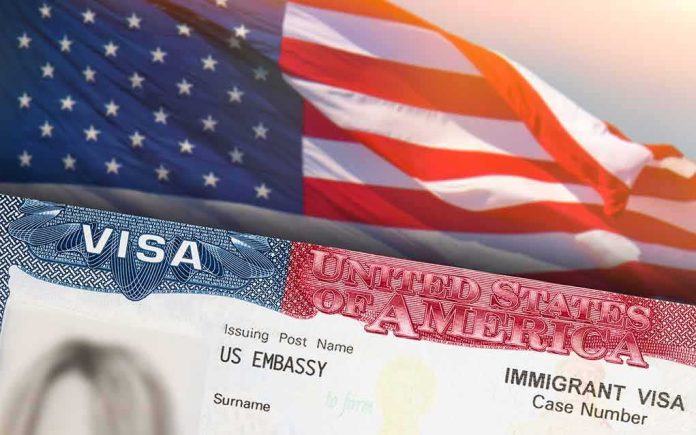
When a government wields visa revocation at scale, it stops being a clerical tool and becomes policy with teeth: a fast, discretionary lever to police how temporary visas are used—and, in this case, to redraw the line between short-stay travel and post-entry asylum.
At a Glance
- The State Department has statutory authority to revoke visas, and it is using that power aggressively under a rolling enforcement model.
- Planned revocations target B1/B2 holders who entered for short stays but later sought asylum, which officials frame as misuse of a visitor category.
- A separate, already-announced campaign revoked more than 175,000 visas for varied grounds, establishing scale and precedent for expanded action.
- Civil-liberties groups are challenging large-scale revocations for due-process deficiencies, and a recent court setback on a different visa policy signals judicial scrutiny.
What the government is actually doing—and why it matters
According to State Department materials reported by major outlets, the administration is preparing a rolling revocation sweep focused on B1/B2 visa holders who later filed for or are seeking asylum, with the scope discussed as up to 200,000 cases. A department spokesperson described the initiative as dynamic and phased rather than a single mass action. The premise is straightforward: business and tourism visas are for short, transient stays; converting that foothold into a protection claim after arrival is, in the government’s framing, evidence that the original temporary-intent representation was unreliable and that the visa is properly withdrawn. While revocation does not itself decide the asylum claim, it strips the travel credential the government no longer views as warranted for that traveler profile.
This push does not arise in a vacuum. Two pillars undergird it. First, the department publicly announced that it has already revoked more than 175,000 visas in recent months for a range of grounds—violating visa terms, criminal conduct, fraud, incitement, and national-security concerns—demonstrating operational capacity and an appetite for scale. Second, long-standing law vests revocation discretion squarely in the executive branch. The Immigration and Nationality Act authorizes the Secretary of State to revoke a visa at any time, and consular officers to do the same, with implementing regulations reflecting that breadth of discretion.
The legal mechanics: discretionary power, limited review
Visa issuance is a forward-looking prediction about eligibility and intent; revocation is its backward-looking counterpart, triggered by post-issuance information that alters that prediction. Under 8 U.S.C. § 1201(i), the Secretary of State may revoke a visa at any time, and consular officers possess parallel authorities in statute and regulation. Congressional Research Service summaries make two points that matter here. First, revocation is an executive function with wide latitude. Second, judicial review of an individual revocation is sharply constrained, typically surfacing only if the revocation is the sole ground for removal and the case proceeds into immigration court. In practice, the programmatic constraint on overbreadth is not court-by-court vetting but administrative policy design and oversight audits.
That is also why past Government Accountability Office work on visa revocations is relevant. GAO has documented the process flow—how revocation certificates are generated and communicated across agencies—and flagged gaps that can arise when speed and scale outpace procedure. The through-line in those reports is not that revocation is extraordinary; it is that high-volume revocation requires disciplined notice, records, and interagency coordination to avoid error propagation.
The policy theory: visitor intent versus protection claims
The department’s rationale, as described in the reporting, targets a specific pattern: entry on B1/B2 for a short stay followed by an asylum filing. The government casts this as category misuse rather than a condemnation of asylum per se. In public remarks, Secretary of State Marco Rubio has articulated a simple screening question for revocation decisions: had we known this information at issuance, would we have admitted the traveler? If the answer is no, revoke. Put differently, an asylum filing can be treated as a post-issuance data point that undermines the temporary-intent representation at the heart of a B visa. That is a defensible consular logic, even if it remains controversial in the humanitarian community, because the logic separates the travel document (a privilege tied to intent and conditions) from the asylum adjudication (a protection claim with its own legal standards).
Scale is the accelerant. The prior announcement of more than 175,000 revocations establishes both the legal authority and operational precedent for a large campaign, even while the department emphasizes rolling, case-by-case action rather than a single, undifferentiated purge.
Where the friction is genuine: due process and category overreach
The strongest counter-arguments do not deny the statutory power; they contest how it is being exercised at volume. Civil-liberties organizations and student advocates have filed and advanced lawsuits challenging earlier, category-like revocations and downstream terminations of status records, arguing that database-driven actions lacked individualized review and deprived people of notice and a meaningful opportunity to respond—classic due-process defects under the Fifth Amendment and the Administrative Procedure Act. Those cases arose in the student context, not the asylum-linked B1/B2 initiative, but they preview the playbook: press for disclosure of criteria, insist on individualized determinations, and force the government to defend error rates and remedy pathways.
Courts are signaling that very broad immigration controls can draw skepticism. A federal judge recently vacated a separate State Department policy freezing immigrant visa processing across 75 countries, criticizing its overbreadth and ordering reconsideration. That ruling does not reach the asylum-linked B1/B2 revocations, but it is a cautionary tale: when policy construction leans on nationality or crude categories, judicial review can bite—and reputationally, adjacent programs can feel the backlash.
Implications for travelers, applicants, and the system
For individuals, visa revocation has immediate travel consequences—airline boarding denials, canceled multipliers for repeat entry—and can trigger downstream immigration actions. It does not extinguish an asylum claim; protection cases proceed under their own statutory scheme. But a revoked B visa changes the legal posture from “temporary visitor with a pending claim” to “protection applicant without a visitor credential,” which can affect discretionary judgments across the system. Because consular decisions are largely nonreviewable, the practical venue for contesting mistakes becomes administrative reconsideration or, if removal is initiated, the immigration courts.
For the system, the core tension is durable. Visa policy is built on categorical judgments about intent; asylum is built on individualized fear and risk. When a government treats the filing of an asylum application as evidence that the original temporary intent was not bona fide, it protects the integrity of the visitor category but risks chilling legitimate protection seekers who used the only lawful door they could access. Sustaining legitimacy at scale therefore hinges on process: clear criteria, documented individualized review, and intelligible notice to affected parties. Those are not luxuries; they are how a discretionary regime proves it is a scalpel, not a cleaver.
𝐓𝐑𝐔𝐌𝐏 𝐀𝐃𝐌𝐈𝐍. 𝐏𝐋𝐀𝐍𝐒 𝐌𝐀𝐒𝐒 𝐕𝐈𝐒𝐀 𝐑𝐄𝐕𝐎𝐂𝐀𝐓𝐈𝐎𝐍 𝐅𝐎𝐑 𝐅𝐎𝐑𝐄𝐈𝐆𝐍𝐄𝐑𝐒 𝐒𝐄𝐄𝐊𝐈𝐍𝐆 𝐀𝐒𝐘𝐋𝐔𝐌 🇺🇸#Trump admin to revoke 200,000+ #visas of foreigners in U.S. #B1 / #B2 business & tourist visas before seeking #asylum. https://t.co/wLrJeof9dN pic.twitter.com/W9fhrhCQCs
— MAMBO (@MamboJournal) August 25, 2026
What to watch next
Three developments will determine whether this initiative endures. First, whether the department publicly clarifies case-selection criteria and review safeguards—transparency dampens litigation risk and error rates. Second, whether audits or oversight bodies validate accuracy and the quality of individualized determinations, especially when analytics flag cases for revocation. Third, how courts treat challenges that blend due-process theories with claims of categorical overreach. The legal baseline—broad statutory authority to revoke—favors the executive. The operational burden—showing this discretion is exercised with precision—now sits squarely with it.
Sources:
redstate.com, thehill.com, usnews.com, tass.com, theguardian.com, state.gov, congress.gov, myattorneyusa.com, gao.gov, community.lawschool.cornell.edu