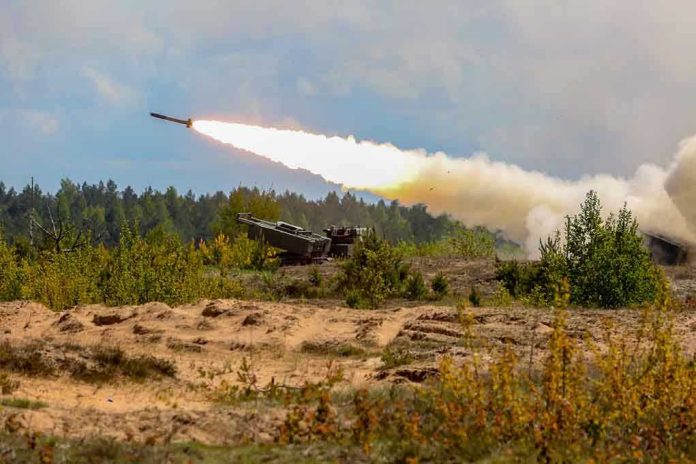
A viral “missile video” is fueling claims that U.S. forces hit an Iranian girls’ school—but the most important fact is what still hasn’t been proven.
Quick Take
- The New York Times analysis, as summarized by the Times of Israel, suggests a school in Minab, Iran, was likely struck accidentally during U.S. operations targeting a nearby IRGC naval base.
- Iranian authorities reported 175 deaths, largely children, but that toll has not been independently verified in the available reporting.
- President Trump publicly blamed Iran, saying inaccurate Iranian drones caused the strike and insisting Iran targets civilians.
- U.S. officials acknowledged operations in the area but denied intentional civilian targeting and said an investigation is ongoing.
What the NYT Analysis Claims—and What the Public Video Does Not Prove
Reporting summarized by the Times of Israel says a New York Times visual investigation tied the February 28, 2026 strike in Minab, southern Iran, to U.S. military activity aimed at an adjacent Islamic Revolutionary Guard Corps naval base. The key claim is proximity and timing: the school and the IRGC site were hit during the same operation, implying accidental collateral damage rather than a deliberate strike.
That framing matters because much of the public narrative online relies on a “new video” said to show a U.S. missile hitting the school. The research provided here does not establish that the video alone identifies the weapon, the launch platform, or the operator. The sources instead emphasize geospatial and temporal analysis and note that attribution remains disputed while a U.S. investigation continues.
Minab’s Location Problem: Civilian Sites Next to IRGC Assets
The central detail repeated across the available coverage is that the girls’ elementary school sat next to an IRGC naval base—exactly the kind of co-location that turns civilians into human shields and propaganda fodder. When a regime embeds military assets among civilian infrastructure, it raises the odds that any strike on legitimate military targets will produce horrifying images for global media, regardless of the attacker’s intent.
Trump’s Public Position Conflicts With Media Attribution
As of March 8, 2026, President Trump publicly rejected the idea that U.S. forces hit the school, instead blaming Iran. In remarks cited via Reuters reporting referenced in the research, Trump said he had “seen” it was done by Iran and argued Iran’s munitions are “very inaccurate,” adding that “the only side that targets civilians is Iran.” The provided research includes no supporting evidence offered alongside that claim.
What’s Confirmed, What’s Claimed, and Why Verification Matters
Several critical elements remain unresolved based on the research. Iran’s reported death toll of 175 is attributed to Iranian authorities and is explicitly described as unverified independently. U.S. officials reportedly acknowledged operations nearby but maintained there was no intentional strike on civilians, and they continued investigating. In a war where information warfare moves faster than facts, responsible conclusions require more than viral clips and partisan certainty.
For Americans watching from home, this episode is also a reminder of how quickly foreign adversaries and sympathetic media ecosystems can exploit tragedy to pressure U.S. decision-making. The constitutional principle at stake is not “trust the government” or “trust the internet,” but demanding accountable proof—especially when accusations could escalate conflict, invite retaliatory attacks, or be used to justify expanded executive power without clear, verified facts.
Sources:
NYT Report Suggests Iran Girls School Next to IRGC Base Was Accidentally Struck by US