

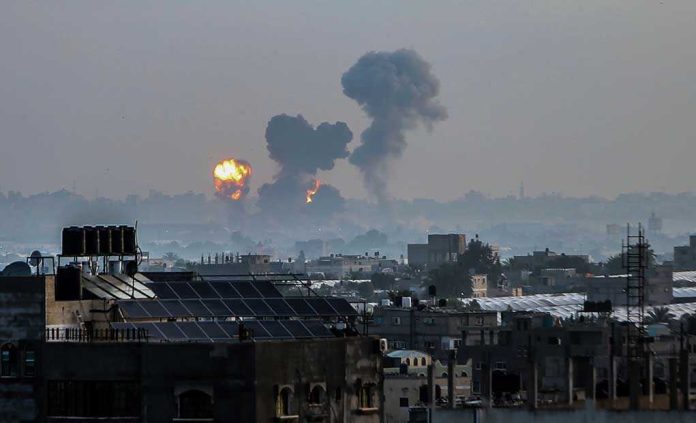
Ukrainian drones just torched a Black Sea oil terminal that handles roughly one million barrels per day—20% of Russia’s seaborne oil exports—and Moscow’s scrambling to downplay a fire that satellite data confirmed in real-time.
Story Snapshot
- Ukrainian drones struck the Sheskharis oil terminal near Novorossiysk early Monday, igniting fires at Russia’s largest Black Sea crude loading point handling 3.5-4.5 million tons monthly
- The attack compounds a 43% collapse in Russian oil exports from late March strikes on Baltic ports, costing Moscow roughly $1 billion weekly
- Krasnodar Governor Veniamin Kondratyev confirmed drone attacks and residential damage but avoided explicitly acknowledging the terminal hit, while unverified social media videos showed flames engulfing the facility
- Ukraine’s intensified drone campaign targets energy infrastructure funding Russia’s war machine, exploiting surging global oil prices from Middle East conflicts to maximize economic and strategic damage
Precision Strikes on Russia’s Oil Jugular
The Sheskharis terminal operates as the endpoint of Russia’s vast oil pipeline network, run by state-owned Transneft. Ukraine claims the facility directly fuels Russian forces invading Ukrainian territory. By hitting Sheskharis in the early hours of Monday, Ukrainian forces demonstrated the reach and precision of their drone capabilities—striking a target over 1,000 kilometers from frontlines. Satellite data and social media footage confirmed fires erupted at the site, though Russian authorities carefully avoided naming the terminal in official statements. Governor Kondratyev acknowledged drone debris at enterprises and damage to residential buildings, a familiar pattern of obfuscation designed to minimize public perception of infrastructure vulnerability.
This wasn’t a one-off gambit. Ukraine previously struck the same terminal on March 2, and hit the nearby Chernomortransneft oil depot in November 2025. The consistency reveals a calculated strategy: degrade Russia’s ability to export oil, choke off war revenues, and pressure Moscow’s budget as global energy markets tighten. The timing matters. With oil prices spiking due to U.S.-Israeli-Iran tensions, every barrel Russia can’t ship compounds lost revenue. The attack on Sheskharis directly threatens the cash flow propping up Putin’s military operations, a reality that explains why Ukraine keeps returning to these high-value targets despite inevitable Russian air defense responses.
Compounding Chaos Across Export Hubs
The Sheskharis strike didn’t occur in isolation. Late March saw Ukrainian drones pummel Baltic Sea ports Ust-Luga and Primorsk, triggering explosions and fires that halted shipments. Russian oil exports nosedived 43% to 2.318 million barrels per day between March 22-29, erasing roughly $1 billion in weekly revenue. Ust-Luga alone supplies 8% of the world’s naphtha; post-strike, that supply plummeted 70%, rattling global refining markets. Leningrad Governor Aleksandr Drozdenko confirmed kamikaze drone impacts, while strikes also hit the Novatek gas plant and Vyborg port. Each attack chips away at Russia’s sanctions-evasion infrastructure, forcing tankers to reroute or sit idle.
Ukraine’s drone offensive targets a strategic chokepoint: Russia’s reliance on seaborne exports to sustain wartime budgets. Western sanctions already constrained Moscow’s oil sales; these strikes make evasion logistically nightmarish. The Tikhoretsk oil hub in Krasnodar region also burned following a Ukrainian strike, demonstrating that no facility—coastal or inland—sits beyond Kyiv’s operational envelope. For Russia, the asymmetry stings. Ukrainian drones cost a fraction of the infrastructure they destroy, and air defenses struggle against low-flying swarms. Moscow’s counter-drone strikes on Ukrainian cities escalate casualties but fail to stop the economic hemorrhaging.
Strategic Leverage Before Diplomatic Showdowns
Ukraine’s ramped-up energy strikes carry diplomatic subtext. By crippling export terminals, Kyiv strengthens its negotiating position ahead of potential talks, signaling it can sustain economic pressure indefinitely. Moscow faces a dilemma: divert resources to protect sprawling oil infrastructure or maintain offensive operations in Ukraine. The $1 billion weekly losses from Baltic strikes alone strain Russia’s ability to fund both. Meanwhile, global oil markets absorb the shock—naphtha shortages ripple through refineries, crude supply tightens, and prices inch upward. Ukraine’s strikes exploit Russia’s geographic vulnerability: terminals like Sheskharis concentrate massive export volumes in single, exposed locations.
Russian officials downplay the damage, framing strikes as minor inconveniences rather than strategic blows. Governor Kondratyev’s refusal to confirm the Sheskharis hit reflects a broader pattern—acknowledge attacks to justify air defense budgets, but obscure specifics to avoid admitting infrastructure fragility. Ukrainian sources counter with direct claims and social media evidence, verified by satellite thermal imaging showing fires. The truth lies in export data: repeated terminal strikes correlate with sharp declines in barrels shipped. Russia’s seaborne oil exports, already crimped by sanctions, now face a kinetic threat that Western embargoes alone couldn’t achieve. For energy firms and global buyers, reliability evaporates when terminals burn monthly.
The long-term implications cut deeper than immediate revenue losses. Repeated strikes erode confidence in Russia’s Black Sea export routes, potentially shifting buyers toward alternative suppliers. Insurance premiums for tankers loading at Novorossiysk will climb, further squeezing profit margins. Ukraine, meanwhile, refines its drone tactics with each sortie—learning air defense gaps, optimizing flight paths, and escalating the economic cost of Putin’s war. This isn’t just tactical harassment; it’s a sustained campaign to defund the invasion by making Russian oil infrastructure unreliable. Moscow’s counter-strikes intensify, but every terminal fire proves Ukraine can reach Putin’s wallet, one drone at a time.
Sources:
Ukrainian Drone Attack Triggers Fire at Key Russian Black Sea Oil Terminal – Reports
Kyiv Post Coverage of Oil Hub Strike
Ukraine Hits Russian Oil Terminal as Moscow’s Drone Strikes Intensify