

Russia just sent a bomber-led formation toward Alaska again—and NORAD’s rapid intercept shows why Americans can’t afford to get complacent about homeland defense.
Story Snapshot
- NORAD detected multiple Russian military aircraft operating inside the Alaskan Air Defense Identification Zone (ADIZ) on Feb. 19, 2026.
- The Russian formation included two Tu-95 strategic bombers, two Su-35 fighters, and an A-50 early warning/control aircraft.
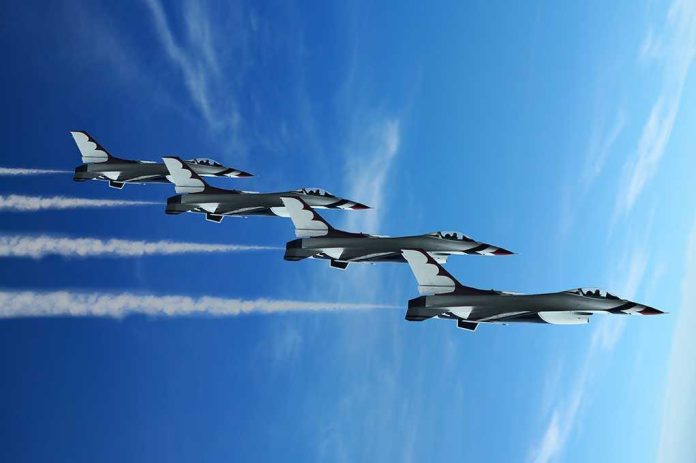
- U.S. and Canadian forces launched F-16s, F-35s, an E-3 Sentry, and KC-135 tankers to identify and escort the aircraft.
- NORAD reported the Russian aircraft stayed in international airspace and were escorted out of the ADIZ.
- Reporting indicates the Alaska ADIZ activity has become frequent in 2026, reinforcing a pattern of testing North American readiness.
NORAD’s Feb. 19 Intercept: What Happened and What It Didn’t
NORAD tracked a group of Russian military aircraft operating in the Alaskan Air Defense Identification Zone on February 19, 2026. The formation included two Tu-95 bombers, two Su-35 fighters, and an A-50 aircraft used for airborne early warning and control. U.S. and Canadian forces responded with interceptors and support aircraft to identify the planes and monitor their flight. NORAD said the aircraft remained in international airspace throughout the encounter.
The North American response was also notably layered. Reporting on the intercept describes U.S. and Canadian forces launching two F-16s, two F-35s, one E-3 Sentry airborne warning aircraft, and four KC-135 refueling tankers. That mix matters because it signals more than a simple “show of presence”—it demonstrates the ability to sustain fighters at distance, maintain command-and-control coverage, and coordinate across the binational NORAD framework that protects the U.S. and Canada together.
Understanding the ADIZ: Not Sovereign Airspace, Still a Serious Security Zone
The Alaskan ADIZ is not U.S. sovereign airspace, and that distinction matters for honest analysis. An ADIZ is a defined area of international airspace where aircraft are expected to identify themselves for national security purposes. Russia’s aircraft, according to NORAD’s statement as described in multiple reports, did not cross into U.S. or Canadian territorial airspace. Even so, these approaches force real-world reactions: tracking, scrambling, communications, and escorting—precisely the kind of repeated pressure that tests readiness.
NORAD has publicly characterized Russian ADIZ activity as “common” and “not considered a threat” in itself, but the same coverage also frames the flights as widely seen efforts to test U.S. and allied preparedness. That dual reality is the key takeaway for Americans: a flight can be legally in international airspace while still being strategically provocative. The purpose is not necessarily to start a fight; it can be to gather data on response times, sensor coverage, and how quickly North America can coordinate under stress.
Why This Formation Was Different: Bombers, Fighters, and an A-50
This incident stood out because the Russian package included an A-50 early warning aircraft alongside bombers and fighters. In practical terms, that kind of plane can help Russian crews coordinate over long distances, improve situational awareness, and support more complex operations than a lone reconnaissance pass. Reports also described this as a larger formation than some recent encounters near Alaska, which adds weight to the “probing” interpretation without requiring any speculation about imminent attack.
Frequency is part of the story as well. Reporting summarized the February 19 intercept as part of a repeating 2026 pattern, including multiple incidents in roughly a month and a higher year-to-date count. That cadence matters to taxpayers because it drives operational tempo—fighters, tankers, and crews must be ready at any hour in harsh geography. When Washington debates budgets and priorities, this is the concrete reality: deterrence is not a slogan; it is fuel, maintenance, training hours, and functioning command systems.
The Strategic Backdrop: Arctic Competition and a U.S. Readiness Test
Alaska sits on the front line of great-power competition because the Arctic and near-Arctic routes compress distance between adversaries and the U.S. homeland. Prior coverage has documented that Russian activity near Alaska has coincided with broader global tension, including Russia’s war in Ukraine and heightened alertness among NATO countries. Separate reporting has also highlighted precedent-setting joint Russian-Chinese bomber flights near Alaska in past years, underscoring that the region is not a theoretical chessboard—it is active air and maritime space.
The February 19 intercept also reinforces a constitutional, common-sense point for a country that values sovereignty and self-defense: homeland security starts with clear lines and the capability to enforce them. The facts here show the U.S. and Canada did enforce the line that exists—identification and escort in the ADIZ—without exaggerating what occurred. The bigger question for policymakers is whether sustained modernization of sensors, runways, and interceptor capacity keeps pace with the tempo of these encounters, especially as adversaries learn from every response.
Sources:
U.S. fighter jets scrambled to intercept Russian warplanes near Alaska
NORAD detects Russian planes off Alaska, sends aircraft
High-stakes encounter: Russian aircraft detected off Alaska
NORAD detects Russian planes off Alaska, sends aircraft in response
Russian and Chinese bombers intercepted off Alaska