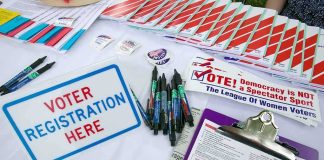
The most important fact about American constitutional guardrails is also the most counterintuitive one: they were never laws in the way a speed limit is a law. They are a lattice of career staff, institutional norms, and internal executive-branch checks that only work if the people staffing them are willing to say no — and that lattice can be dismantled through personnel decisions alone, without repealing a single statute.
Key Points
- ProPublica’s 2025 examination found that at least 75 nonpartisan career officials tied to election security and integrity have left federal agencies, with political appointees — including several who supported the 2020 overturn effort — filling their places.
- Legal analysts describe a broader pattern of eliminating internal executive-branch checks that have functioned “massively” since the 1970s, alongside judicial appointments criticized by the American Bar Association.
- Brookings has argued the opposite conclusion about Trump’s first term: that formal institutional powers remained intact and no branch of government permanently lost legal authority.
- The dispute increasingly turns on a distinction between formal power, which appears preserved, and informal capacity — staffing, independence, and willingness to resist pressure — which multiple sources say has eroded.
- Much of the documentary record — personnel orders, staffing rosters, internal DOJ communications — remains outside public view, meaning the argument is still being fought largely through reporting and commentary rather than released records.
What a Guardrail Actually Is, and Why It’s Fragile
Constitutional scholars distinguish between two kinds of restraint on presidential power. The first is formal: the text of the Constitution, statutes, and judicial precedent that assign authority to Congress, courts, and independent agencies. The second is informal — the career civil servants who apply the law regardless of who appointed them, the internal counsel’s offices that flag unlawful orders before they’re issued, the inspectors general who audit after the fact, and the unwritten expectation that a president will not simply fire everyone who disagrees with him. A 2025 discussion of judicial checks noted that this second layer, “supplemented” since the 1970s by internal executive-branch mechanisms, has become “massively important” precisely because Congress and the courts move too slowly to catch abuses in real time.
That second layer is exactly what critics say has been targeted. Untelevised Media’s account of a new federal personnel category — “Schedule Policy/Career” — describes a mechanism that strips job protections from career employees in policy-influencing roles, making them easier to replace with loyalists. The piece frames this as “executive aggrandizement,” a term political scientists use for a leader who uses the ordinary powers of office to weaken the institutions meant to check him. Unlike a dramatic firing or a defiant court order, this kind of change is procedural and largely invisible to the public until the personnel rosters are compared before and after.
The Election-Security Case: The Strongest Documented Example
The most concrete evidence in the current record concerns election administration. ProPublica’s 2025 investigation reported that the guardrails which held during the 2020 overturn attempt — “but just barely” — have since been dismantled at the agency level. Its reporting counts at least 75 career staff gone from election-related federal offices, with political appointees taking their place, including ten people who had previously worked to overturn the 2020 result. That is a specific, countable claim rather than a rhetorical one, and it is the closest thing in the public record to a before-and-after institutional audit.
It matters because election administration is precisely the kind of guardrail that depends on personnel rather than law. The statutes governing federal elections did not change; what changed, according to this reporting, is who sits in the offices responsible for enforcing them. If accurate, the practical effect is that the people who resisted illegitimate pressure once are simply no longer in the building — a distinction between legal authority and institutional will that is easy to overlook and difficult to litigate.
The Counter-Case: Formal Institutions Have Not Collapsed
The strongest rebuttal to the dismantling narrative comes not from partisans but from institutional analysts making a formalist argument. Brookings’ retrospective on Trump’s first term concluded flatly that “the guardrails of democracy held” and that “not a single one” of the major checking institutions — Congress, the courts, federalism, the press, elections — lost legal power during that period. This is a meaningful distinction: no court was abolished, no election was overturned by force, no constitutional amendment was repealed. Judged purely by formal structure, the system survived intact.
The Bulwark’s own analysis reaches a similar concession even while arguing the opposite thesis: “Two and a half years into Donald Trump’s presidency, those guardrails have, for the most part, remained intact,” before pivoting to argue that judicial appointments — including nominees rated “Not Qualified” by the American Bar Association — represent a slower, quieter form of erosion. That combination is worth sitting with: even critics who believe institutional damage is occurring generally do not claim the formal structure of government has been dismantled. Their claim is narrower and, in some ways, harder to prove — that the practical independence of the people who staff that structure has been degraded.
Where the Disagreement Actually Lives
Strip away the rhetorical temperature and the dispute resolves into a genuine, unresolved empirical question: does replacing career staff with political loyalists constitute “dismantling” a guardrail, or is it ordinary — if aggressive — presidential personnel authority that every administration exercises to some degree? The Brennan Center’s position sits between the two camps, arguing that recent years have “underscored the need to reckon with long-term threats” to democratic institutions and calling for legislation such as the Protecting Our Democracy Act to formalize protections that currently rest on norms alone. That framing implicitly concedes Brookings’ point — the guardrails have not formally fallen — while insisting that norm-dependent guardrails are inherently unstable and need statutory reinforcement to survive future pressure.
[Take 13/15 · 𝕏-3]
### 𝕏-3. Senate confirms Todd Blanche as AG 50-49; Sen. Cassidy cites doubts but casts pivotal vote Aug 9
*(as of 2026-08-09)***1. The Frame**
**What people think this is about:** A narrow Senate confirmation of Trump’s former personal lawyer as Attorney…
— GrumpyNews, emotionally clean news. (@GrumpyNews_) August 9, 2026
What’s largely missing from the public record, on both sides, is the underlying documentation that would settle the argument decisively: the personnel orders creating new job classifications, the internal DOJ communications about staffing decisions, the complete before-and-after rosters at agencies beyond the election-security offices ProPublica examined. Congressional oversight, FOIA litigation, and inspector-general reviews are the normal channels through which that kind of record becomes public, and until it does, the debate will continue to be fought largely through investigative reporting, opinion commentary, and dueling institutional retrospectives rather than through documents that speak for themselves.
Why This Matters Beyond the Current Administration
The 2020 overturn attempt is the reference point every source in this debate returns to, because it demonstrated both halves of the guardrail thesis at once: the formal system held — no fake elector slate was certified, no court accepted the fraud claims — but it held by a narrower margin than most Americans realized at the time, dependent on individual officials choosing to resist enormous political pressure. That is the precedent driving current scrutiny of personnel changes: not a claim that democracy has already collapsed, but a documented instance in which its survival depended on people rather than paper. Whichever administration holds power next will inherit whatever staffing and institutional culture existed on the way out, which is exactly why analysts across the ideological spectrum treat personnel decisions, not just formal law, as the metric worth watching.
Sources:
cambridge.org, propublica.org, nytimes.com, youtube.com, usatoday.com, salon.com, thebulwark.com, whitehouse.gov