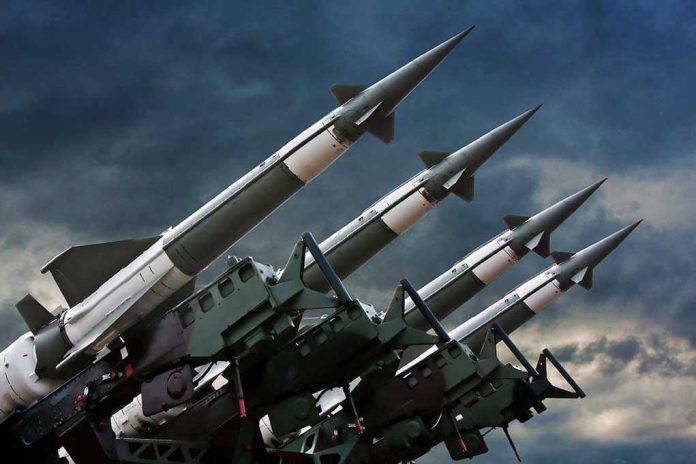
The night sky over Dubai erupted in fireballs as Iranian missiles and drones met their end above one of the world’s most recognizable skylines, captured on video that shows a conflict many hoped would never reach civilian doorsteps.
Story Snapshot
- UAE air defenses intercepted Iranian missiles and drones over Dubai overnight on March 17, 2026, with explosions visible above the city skyline
- The attacks represent Iran’s ongoing retaliation following US-Israeli strikes on February 28 that killed Supreme Leader Ali Khamenei and 1,332 others
- UAE has intercepted nearly 300 ballistic missiles and over 1,600 drones since late February, with 8 killed and 157 injured from debris
- The conflict threatens global oil supplies and economic stability as Iran targets US military bases across Gulf nations including Saudi Arabia, Qatar, and Kuwait
When Defense Systems Light Up the City
Video footage from Clash Report captured what residents of Dubai witnessed in the predawn hours: brilliant explosions punctuating the darkness as air defense systems engaged incoming threats. The interceptions occurred directly over the urban center, a stark reminder that modern warfare no longer respects the invisible boundaries between military installations and metropolitan areas. UAE officials confirmed all projectiles were destroyed before impact, with no injuries reported from this particular salvo. The successful defense marked another entry in a growing ledger of intercepts that has transformed Gulf cities into testing grounds for missile defense technology under real combat conditions.
A War Nobody Expected to Last This Long
The current crisis traces back to February 28, 2026, when US and Israeli forces launched coordinated strikes against Iran during what were supposed to be peace negotiations. The operation killed Iran’s Supreme Leader and triggered an immediate military response that caught regional experts off guard. Iran’s post-Khamenei leadership unleashed waves of ballistic missiles and unmanned aerial vehicles targeting not just Israeli territory but US military installations peppered throughout the Arabian Peninsula. Al Dhafra Air Base in the UAE became a primary target, along with facilities in Qatar, Bahrain, Saudi Arabia, and Kuwait. What military planners anticipated as a brief exchange has stretched into weeks of sustained attacks.
The Toll on Cities and Citizens
While UAE defense systems boast near-perfect interception rates, success carries its own dangers. Debris from destroyed missiles has rained down on residential neighborhoods, luxury hotels including the Burj Al Arab and properties on Palm Jumeirah, and commercial districts. Eight people have died, including two military personnel and a Pakistani national, while 157 others suffered injuries. The cumulative count since late February stands at 298 ballistic missiles and 1,606 drones intercepted, according to the UAE Ministry of Defence. These aren’t just statistics for Dubai and Abu Dhabi residents who have endured airport closures, airspace restrictions, emergency alerts, and shifts to remote learning for their children.
Economic Pressure Points and Oil Anxieties
Iran’s strategy extends beyond military targets to economic warfare. Tehran issued evacuation warnings for areas near oil facilities in Fujairah, signaling intent to strike energy infrastructure that powers global commerce. Fires have already erupted in the Fujairah oil zone, while repeated airspace closures have paralyzed aviation schedules and disrupted tourism. A UAE minister told Euronews that Iran must not hold the global economy hostage, yet that’s precisely the leverage Iran seeks. The proximity of attacks to critical oil infrastructure has sent ripples through energy markets. Gulf residents who expected a quick resolution now watch their cities become frontline positions in a conflict with no clear endpoint.
What Coalition Defense Really Looks Like
The UAE doesn’t stand alone in this aerial chess match. Gulf states have coordinated their defense networks, with Saudi Arabia, Qatar, and Kuwait all reporting successful intercepts of Iranian projectiles during concurrent attacks. Australia has deployed early warning and control aircraft to support UAE operations, and a projectile struck near Australian military headquarters in the Emirates. The cooperation reflects recognition that Iran’s targeting of US bases makes every host nation vulnerable. Yet perfect defense remains impossible. Even with interception rates exceeding 99 percent, the sheer volume of attacks—over 2,000 projectiles launched at the UAE alone—means debris impacts are inevitable, turning successful military operations into civilian hazards.
MISSILES INTERCEPTED: Video shows UAE air defenses intercepting Iranian missiles and drones launched toward Dubai as the country's Ministry of Defense says its air defenses were responding to incoming threats from the Islamic Republic.
All air interceptions were successful, and… pic.twitter.com/LwBAsEJj1Q
— ZiaReports🇺🇸✨ (@ZiaReports) March 18, 2026
The video evidence from Dubai’s skyline provides irrefutable documentation of a conflict that has transformed theoretical defense capabilities into nightly reality. Residents who once viewed missile defense systems as abstract security measures now hear the booms firsthand and see the light trails with their own eyes. The question looming over the Gulf is not whether defenses can continue performing but whether diplomatic channels can halt a cycle of retaliation before economic damage becomes irreversible or a stray projectile causes mass casualties that force even deeper escalation.
Sources:
Watch: UAE air defenses intercept Iranian missiles, drones over Dubai
Gulf Arab states intercept new missiles and drones as Iran threatens to widen war
UAE intercepts four ballistic missiles, six drones
UAE says it intercepted 13 missiles and 39 drones launched from Iran
UAE air defences intercept six ballistic missiles, seven cruise missiles, 39 UAVs
2026 Iranian strikes on the United Arab Emirates
UAE intercepts over 1000 drones since start of Iran war
UAE intercepts 4 missiles, 6 drones from Iran