
President Trump’s appearance at the 2026 Patriot Games finale mattered less as a one-off photo op than as a demonstration of how the White House can turn a youth sports competition into a fully staged political spectacle: arrival, crowd reaction, and ceremonial visibility all became part of the event’s meaning.
Key Points
- The finale was scheduled as a public Trump appearance at Spire Academy in Geneva, Ohio, and multiple contemporaneous reports said he traveled there for the closing event.
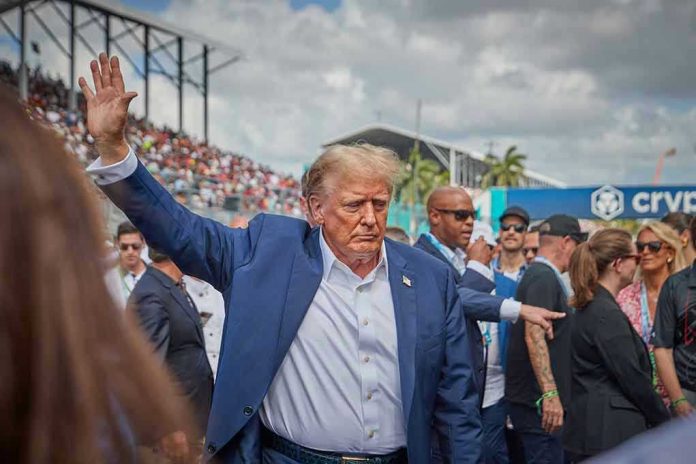
- Published coverage and live video both placed Trump at the center of the finale, with reports describing his arrival, his walk-in, and his attendance with the athletes and audience.
- The Patriot Games themselves were framed as part of America’s 250th-anniversary commemoration, which gave the finale a political and ceremonial weight beyond ordinary sports coverage.
- The “rockstar welcome” framing is best understood as a reaction narrative: the hard fact is attendance, while enthusiasm in the room is the kind of subjective detail that clip-based coverage amplifies most aggressively.
The Finale Was Designed as a Presidential Moment
The basic record is straightforward. Trump went to Geneva, Ohio, for the final day of the Patriot Games, a youth athletics competition tied to the country’s 250th anniversary celebration, and the finale was presented as an occasion built around his presence. The event listing itself invited attendees to “Join President Donald J. Trump and a live television audience for the 2026 Patriot Games Finale,” which tells you everything you need to know about the staging: this was not a neutral sporting finale that happened to receive a presidential visit; it was a presidential visit folded into the event’s identity.
That distinction matters because it explains why the coverage felt so theatrical. Trump’s trip was not improvised; it was scheduled, publicly announced, and embedded in a televised production environment. Multiple reports said he was traveling to Cleveland and then on to Spire Academy in Geneva to attend the finale, and one White House schedule item described him as attending the Patriot Games final in Geneva. In other words, the appearance was structurally expected, not a surprise cameo. The excitement generated by the crowd, therefore, was part of the event design, not an independent political revelation.
What the Patriot Games Actually Are
The Patriot Games were conceived as a national youth competition tied to the semiquincentennial, with teenagers from across the states and territories competing for scholarship money and a primetime broadcast slot. That gives the event a hybrid character that is easy to miss if one looks only at the crowd-shot clips. It is at once a sports showcase, a commemorative ceremony, and a White House-branded cultural production. Those categories overlap, but they are not the same thing. A conventional athletic final is organized around the competition itself; a presidential spectacle is organized around the symbolic power of the presidency.
That is why the finale drew attention beyond the usual high school sports audience. Trump’s presence made the event legible as a political image, while the athletes supplied the emotional and patriotic script. Coverage from the time described the competition as a national event featuring students selected from each state, with a broadcast plan extending beyond the live finale. The result was not merely a game but a mediated ceremony in which the audience, the athletes, and the president all served the same symbolic purpose: to dramatize a celebration of national identity.
Why the “Rockstar Welcome” Frame Travels So Well
Headlines that describe a president receiving a “rockstar welcome” are built for social media circulation because they compress three things into one easily shareable scene: visible enthusiasm, celebrity politics, and crowd theater. The available reporting does support the underlying claim that Trump arrived to a lively, highly visible reception, and footage and photo coverage show him entering the event amid the fanfare of a stage-managed finale. But the stronger point is not that the crowd was loud; it is that the event was assembled to produce precisely this kind of image.
That is a familiar feature of modern political media. Once a president enters a large public setting, especially one already wrapped in partisan branding, the event becomes a contest over optics as much as substance. The first facts to harden are usually the easiest ones to verify — where he went, when he arrived, who organized the appearance, what the public schedule said. The more elastic claims — how ecstatic the crowd was, whether the reaction proved anything durable, whether the scene “changed” the political mood — are where clip culture does most of its work. The video title language belongs to that second category, not the first.
Trump attending final day of 'Patriot Games' in Ohio: What are they? https://t.co/jM0CCOw2wZ
— EYEWITNESS NEWS (@cnyhomepage) August 12, 2026
What This Appearance Says About Trump’s Political Style
Trump’s fit with events like the Patriot Games is not accidental. He has always been most effective in settings where politics, entertainment, and performance blur together, because those settings reward presence, spectacle, and instant visual dominance over procedural detail. The Patriot Games finale offered all of that at once: a national brand, young athletes, flags, broadcast cameras, and a presidential walk-on that turned the closing moments into a governing image rather than merely an athletic one. That is the deeper logic behind the “welcome” narrative. The crowd reaction is the surface; the presidency-as-performance is the structure underneath.
There is also a practical consequence. When the White House attaches presidential prestige to a youth sports event, it elevates the event’s stakes, but it also narrows the distance between state symbolism and campaign-style media logic. The same apparatus that can dignify an occasion can also flatten it into a viral moment. Here, the finale became a story about Trump’s reception because that is what the format rewards, even though the durable fact is simpler: he attended a televised finale in Ohio, and the event was built to showcase him as much as the athletes.
Sources:
thegatewaypundit.com, youtube.com, events.freedom250.org, sports.yahoo.com, upi.com, nytimes.com, cnn.com, time.com