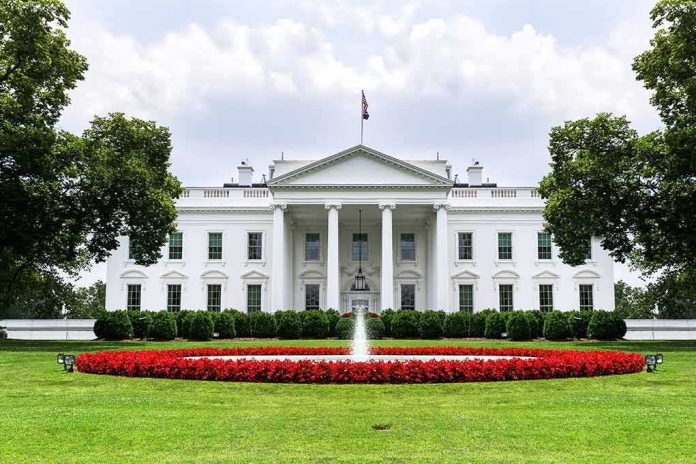
Trump’s choice of Will Scharf as White House counsel is more than a personnel shuffle: it places one of the president’s most trusted lawyers inside the office that vets legal risk, manages internal executive-branch procedure, and helps decide how aggressively the White House can push the limits of presidential power.
Key Points
- President Trump said Will Scharf will become White House counsel effective September 1, replacing David Warrington.
- Scharf is already a senior White House figure as staff secretary and assistant to the president, and he also chaired the National Capital Planning Commission.
- His involvement with the commission matters because it approved the White House ballroom project now tied to Trump’s broader executive-branch agenda.
- The move keeps legal authority close to a loyal aide who has already worked on some of the administration’s most sensitive personnel and institutional decisions.
What the Appointment Actually Changes
According to the reporting, Scharf will move from White House staff secretary to White House counsel on September 1, taking over the president’s top in-house legal post from David Warrington. That is not a ceremonial title. White House counsel sits at the intersection of presidential ambition and legal constraint, reviewing executive actions, personnel questions, ethics issues, litigation strategy, and the practical boundaries of what the administration can do without triggering a lawsuit or a congressional fight. In a White House defined by speed, loyalty, and legal combat, the counsel’s office is one of the few places where process still matters.
The personnel choice is therefore instructive. Scharf is not an outside academic, a Senate-confirmed technocrat, or a neutral institutional lawyer. He is already embedded in Trump’s inner circle, having served as staff secretary and as assistant to the president, roles that place him close to the daily flow of information reaching the Oval Office. That proximity matters because the White House counsel is often less a grand constitutional theorist than a gatekeeper; the lawyer who can tell the president what is possible, what is defensible, and what will almost certainly end up in court.
Why Scharf’s Background Matters
Scharf’s rise reflects a broader Trump-era pattern: key legal and administrative jobs are increasingly assigned to people who combine technical competence with personal trust. Reuters noted that Scharf previously served as a federal prosecutor and represented Trump in several cases, including at the Supreme Court. That résumé is significant. It signals familiarity with prosecutorial mechanics, appellate litigation, and the style of adversarial legal management that has characterized much of Trump’s political career. It also signals something else: the president is elevating someone who has already demonstrated loyalty in the most consequential forum available, his own legal defense.
The Washington Post reported an additional layer of context that helps explain why Scharf’s move has attracted attention: as Trump-appointed chair of the National Capital Planning Commission, he helped secure approval for the $400 million ballroom project. That connection does not by itself prove favoritism; it does show how tightly braided the administration’s legal, political, and construction agendas have become. A White House counsel who has already handled a major presidential priority from another angle enters office with intimate knowledge of the administration’s priorities and its vulnerabilities.
That is precisely why the appointment is consequential. White House counsel is not merely a compliance officer. The office often becomes the first line of defense when executive action is challenged, and the first line of offense when the administration wants to press constitutional or statutory boundaries. Scharf’s background suggests a lawyer comfortable with hard-edged institutional strategy rather than passive risk avoidance. For a president who prizes speed and loyalty, that is an asset. For those who want cleaner separation between legal advice and political alignment, it is a warning sign.
The Ballroom Connection Is Politically Important
The ballroom project is not a side note; it is part of the reason Scharf’s appointment reads as strategically deliberate. Reporters noted that Scharf chaired the National Capital Planning Commission, the executive-branch body with jurisdiction over construction and major renovations to government buildings in the region, and that the commission approved the ballroom plan. In practical terms, this means Scharf was already involved in a high-stakes project that sits at the fault line between executive initiative and legal challenge. Moving him into the White House counsel role keeps that institutional memory inside the president’s legal apparatus.
This matters because the ballroom project has already become a test case for presidential authority. Reuters reported that a federal appeals court later ordered the administration to stop construction on the $400 million project, saying that a president is a “temporary tenant, not the owner” of the White House and cannot fundamentally reshape it without congressional approval. In that setting, the distinction between architect, advocate, and lawyer blurs. Scharf’s transition into counsel suggests the administration wants its legal guidance shaped by someone who understands not just the law, but the political and bureaucratic terrain around one of Trump’s signature projects.
Big move from the Trump administration. Scharf brings a strong legal background to the role, and his performance as White House counsel will be closely watched. The next chapter should be interesting.
— AmericaBrief (@AmericaBriefUS) August 10, 2026
What to Watch Inside the White House
The immediate question is not whether Scharf is qualified in a generic sense; the record shows a lawyer with prosecutorial experience and familiarity with Trump’s legal battles. The more important question is what his appointment signals about the administration’s operating model. A White House counsel who has spent years in the president’s orbit may be more effective at translating political will into legally survivable action, but may also be less inclined to create friction when the White House is tempted to move quickly or test the edges of executive power. That tradeoff is the essence of the appointment.
Warrington’s departure to the private sector closes one chapter, but the larger pattern remains intact. Trump is placing a trusted aide into a post designed to slow the president down when necessary. In a more traditional administration, that role can serve as a brake. In this one, it is more likely to serve as a navigation system: not whether to proceed, but how to proceed with minimal exposure. Scharf’s move, in other words, is less a routine personnel change than a statement about how Trump intends to govern through legal architecture as much as through political force.
Sources:
mediaite.com, reuters.com, washingtonpost.com, politicalwire.com, krcgtv.com, yahoo.com