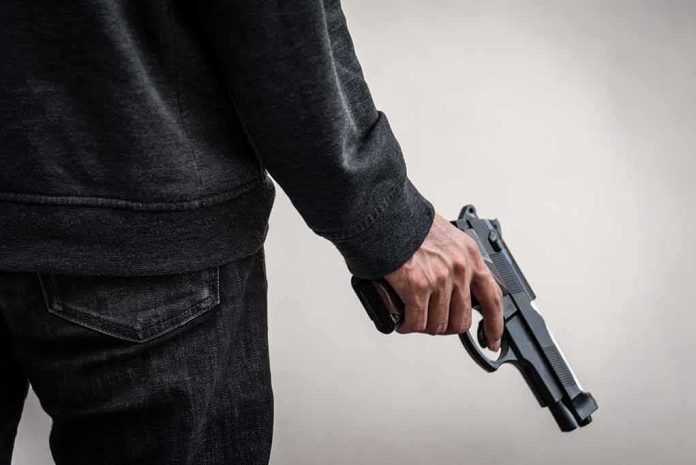
The central fact in this Florida case is not merely that two minors were charged; it is that investigators say a tip, digital messages, and a home search converged into a robbery-and-weapons investigation serious enough to produce adult prosecution for one teen and felony charges for the other.
Intro Header
- Authorities say the case began with a school-district tip about a threatening text conversation and an anonymous report that included video from Telegram.
- Police and local reporters describe homemade firearms, explosive material, and improvised restraints recovered during searches.
- The robbery allegation is specific enough to matter: officials say the target was an unknown person behind a grocery store.
- The public record available here is still mediated through secondary reporting, so the strongest claims rest on law-enforcement summaries rather than the full charging file.
How the case was built
According to ABC News, the investigation began in late April after the St. Johns County School District received a tip about a threatening text conversation involving homemade weapons and a plan to rob someone. ABC also reports that the anonymous tip reportedly included video of an April 16 Telegram exchange in which the teens discussed robbing a person at gunpoint and splitting the proceeds. That sequence matters because it shows the case did not begin as a vague suspicion about dangerous behavior; it began as a specific allegation of coordinated planning, tied to contemporaneous digital communications.
Authorities then say the inquiry moved from messaging to physical evidence. ABC reports that a search of Julian Davis’s home turned up three homemade firearms, ammunition, and zip-ties fashioned into handcuffs; two of the seized firearms reportedly fired during a functionality test, while a third did not. WUSF adds that deputies said the evidence at the 14-year-old’s northwest St. Johns County home included makeshift firearms built from hardware-store items, information on how to build explosives and homemade ammunition, and materials espousing the Great Replacement Theory. In other words, the state’s case, as publicly described, is not built on one discarded note or one overheard remark. It is built on an alleged chain: digital planning, corroborating tip, search warrants, and recovered objects that investigators characterize as operationally meaningful.
What the public record says the teens allegedly planned
The robbery allegation is unusually concrete for a juvenile case of this kind. ABC says authorities described the intended victim as an unknown person behind a grocery store. Action News Jax likewise reported that the teens were charged after allegedly creating homemade bombs and guns and planning to use the weapons to commit a robbery. That specificity does not prove the offense occurred, but it does distinguish this case from the looser category of “threats” that often remain aspirational or fantastical; investigators are describing an actual target area, a proposed method, and a division of proceeds.
At the same time, the public reporting still leaves important legal and forensic questions open. The sources available here do not include the underlying arrest affidavit, warrant return, or full Telegram screenshots; they summarize law-enforcement claims rather than reproduce the complete probable-cause record. That matters because the legal strength of a conspiracy or attempt case often turns on details the public never sees at first: who authored the messages, how device data were extracted, whether timestamps align, and whether the seized items meet the technical definition of firearms or destructive devices under Florida law. ABC does report that two of the homemade guns fired in testing, which strengthens the weapons allegation materially, but the broader evidentiary architecture remains visible only in outline.
Why the weapons evidence changes the case
Homemade weapons cases are different from ordinary possession cases because their evidentiary value depends on function, design, and intent. A crude object may look threatening yet be legally ambiguous; a device that can discharge a projectile, by contrast, is far easier for prosecutors to frame as a firearm rather than a mere prop. ABC’s report that two of the seized weapons successfully expelled a projectile during testing is therefore central, not incidental. It gives the state something beyond appearance: a functional demonstration that at least part of the alleged arsenal was capable of firing.
WUSF and Action News Jax both reinforce that the recovered material was not limited to one odd homemade item. The reporting describes a cluster of objects: makeshift firearms, ammunition, handcuff-like zip ties, handwritten construction notes, chemical-reaction diagrams, manifesto-style books, and a tactical vest marked with white-supremacy imagery. That combination is why authorities can present the case as a weapons-and-planning matter rather than as a school prank gone badly wrong. It also explains why media coverage has tended to frame the episode as a “cache” rather than a single episode of possession. The alleged conduct, as reported, is cumulative.
The broader pattern this case fits
This is not an isolated Florida template; it fits a recurring pattern in youth-threat prosecutions. A tip arrives, often from a school or online platform; investigators examine messages; searches follow; and charges are drafted to cover planning, possession, and conspiracy. The provided reporting shows that exact arc. ABC says the school-district tip initiated the case, and WUSF says the sheriff’s office announced charges after the arrests and searches were already complete. That sequence is typical because the state usually needs a digital lead or witness tip before it can persuade a judge to authorize intrusive searches.
The recurring feature of these cases is also the source of their public confusion. When authorities announce recovery of weapons, explosives-related material, and threatening messages, the public tends to assume the case is already fully proven. It is not. What is proven at the charging stage is only that police believe they have enough to proceed. Yet this case is stronger than the average vague threat report because the alleged conduct spans messaging, physical construction, and a target-specific robbery theory. That is why the charges are serious, even before a court tests them.
What still matters most as the case moves forward
The decisive questions now are the ones that determine whether an alarming arrest narrative becomes a sustainable prosecution. Were the Telegram messages authenticated through device extraction? Did the searches recover parts that can be linked to the teens’ own hands and plans? Were the homemade firearms assembled in a way that satisfies statutory definitions, and were they recent enough to support the timing the state alleges? The public reporting does not answer those questions in full, but it does supply enough to show why prosecutors viewed the case as more than speculative. This is a case where intent, means, and alleged preparation all reinforce one another.
Juvenile status complicates the public’s view and the court’s access. WUSF reports that the 14-year-old faces eight felony charges and is being tried as an adult, while the 13-year-old faces a conspiracy-to-commit-robbery charge and was released from custody. That split is revealing. Prosecutors appear to be treating the older teen as the more central actor, a judgment echoed in Action News Jax’s description of him as the figure behind the weapons construction and the planning. For readers, the important thing is to keep the case anchored to what the evidence package actually supports: investigators say the teens planned an armed robbery, built or possessed homemade weapons, and left behind enough material for charges to follow.