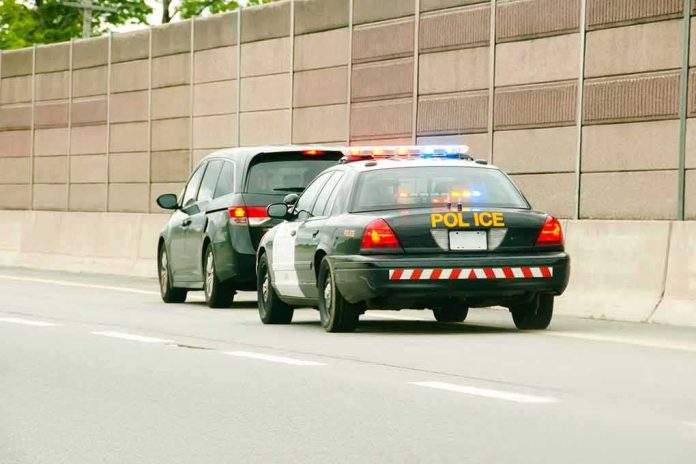
The central fact here is not mystery but mechanism: a stationary Tennessee Highway Patrol cruiser was struck from behind during a roadside stop, and the footage was released as a blunt warning about how quickly ordinary inattention turns a traffic stop into a secondary crash. The deeper lesson is that rear-end impacts on the shoulder are among the most dangerous and most misunderstood law-enforcement incidents precisely because the camera makes the collision legible long before the full investigative record does.
Intro Header
- The released video shows a vehicle striking the rear of a parked THP cruiser and pushing it into the stopped SUV ahead of it.
- THP used the footage to reinforce Tennessee’s Move Over Law and the duty to slow down when emergency lights are present.
- The public record supplied here supports the basic crash sequence, but it does not include a full crash report, citation record, or reconstruction.
- That gap matters because visual evidence can clarify what happened without fully explaining why it happened.
What the footage actually establishes
The strongest part of the record is the physical sequence. THP’s released dashcam and bodycam footage, as summarized by multiple outlets, shows a patrol car already stopped on the shoulder during a traffic stop when another vehicle hit it from the rear, forcing the cruiser into the vehicle that had been pulled over in front of it. ABC’s summary says the trooper was not seriously injured, and THP framed the release as a reminder to slow down and move over when approaching emergency vehicles with flashing lights. That is the core event, and on that point the supplied material is consistent.
Just as important is what the footage implies about vulnerability. A cruiser parked on the shoulder is not in traffic flow, but it is not safe. It is a fixed target in a narrow corridor, often with a guardrail on one side and moving traffic on the other. In the THP account quoted by later coverage, the trooper had just stopped a vehicle traveling 97 mph in a 70 mph zone before the impact occurred. That detail matters because it shows the stop was not incidental; it was a standard enforcement action already in progress when the collision folded a second hazard into it.
Why THP released the video as a Move Over Law case study
THP did not release the footage as a neutral archival clip. It released it as a teaching instrument, explicitly tying the crash to Tennessee’s Move Over Law and urging motorists to slow down and shift lanes when they can safely do so. That is the institutional logic behind many roadside-crash releases: the agency uses a vivid, easily understood event to make a legal duty concrete. In this case, that strategy works because the video does not need embellishment. A rear-end strike on a parked cruiser is visually self-explanatory, and the danger to the trooper is immediate and unmistakable.
The law-enforcement side of the message also rests on a real operational problem. Roadside stops are among the most exposed moments in policing. The officer is outside the moving stream, but still within it; the stopped driver, the cruiser, and the shoulder all create a compressed work zone. In that setting, even a single following driver who fails to slow down can convert a routine enforcement stop into a chain-reaction event. That is why these videos circulate so effectively. They are not merely dramatic; they are didactic. They show how little margin exists between compliance and catastrophe.
What the public record does not yet settle
The supplied material is strong on the fact of impact and thin on the investigative aftermath. It does not identify the striking driver, provide a citation or arrest report, or include a formal crash reconstruction for the Davidson County incident. It also does not supply the full pre-impact video sequence, so the driver’s exact lane position, braking behavior, and any evasive effort remain unknown. Those are not minor omissions in a legal sense. They are the difference between a persuasive public warning and a complete causal account.
The same limitation applies to conditions. THP’s public framing emphasizes driver conduct, but the record provided here does not analyze weather, lighting, shoulder condition, roadway geometry, or visibility in forensic detail. None of that erases the rear-end collision captured on video; it simply means the public materials do not yet answer every question a reconstructionist would ask. In serious traffic-safety analysis, that distinction matters. A video can prove impact. It does not always prove the whole chain of avoidable error that led to it.
A shocking dashcam video released by the Tennessee Highway Patrol shows the moment a patrol cruiser was blindsided during a traffic stop, sending it crashing into another vehicle. https://t.co/diRDFza5oe
— FOX 7 Austin (@fox7austin) August 7, 2026
How to read the competing narratives
There is a genuine difference between skepticism and contradiction, and this case is not one where the adversarial record undercuts the agency’s core claim. The supplied counter-material does not produce a named witness statement, sworn rebuttal, alternate video analysis, or legal filing contesting the rear-end impact. Instead, it mainly highlights what remains unavailable: the crash packet, the full metadata, the driver’s account, and any formal charging documents. That is a legitimate evidentiary caution, but it is not a competing factual narrative strong enough to displace the THP account.
So the right reading is proportioned. The public evidence is sufficient to say a Tennessee Highway Patrol cruiser was struck from behind during a roadside stop, that THP released the footage, and that the agency used the incident to underscore Move Over Law compliance. It is not sufficient to resolve every contributing condition or to treat the public clip as a complete substitute for the investigative file. In other words, the headline story is real; the legal and causal story is still narrower than the viral video suggests.
Why these clips resonate beyond this single crash
Roadside-collision videos travel because they compress a complicated safety problem into one devastating second. They also invite a familiar moral shorthand: careless driver versus vulnerable trooper. That shorthand is not baseless here; it is exactly what a rear-end impact on a parked cruiser looks like at first glance. But the broader lesson is more structural. Police, motorists, and safety agencies all operate in an environment where a short clip can dominate the public mind before the record catches up. That is why the most responsible reading of the THP footage is both firm and bounded: the collision is clear, the warning is warranted, and the complete investigative file would still matter.
Sources:
nypost.com, youtube.com, facebook.com, instagram.com, titan.safety.tn.gov