Oil tankers just crept back through the world’s most dangerous stretch of water, and the way they did it quietly rewrites what “crisis” really means in the Strait of Hormuz.
Story Snapshot
- Tanker crossings plunged to a wartime low, then snapped back to normal-range levels within days.
- Iranian forces shifted from firing missiles and drones to selectively “allowing” ships through.[1][6]
- Trump’s “Project Freedom” escorts and public threats collided with Iran’s new Strait authority claims.[1][5]
- History shows markets adapt fast, even when Hormuz becomes a shooting gallery.[4]
How Tanker Traffic Bounced Back From a Wartime Low
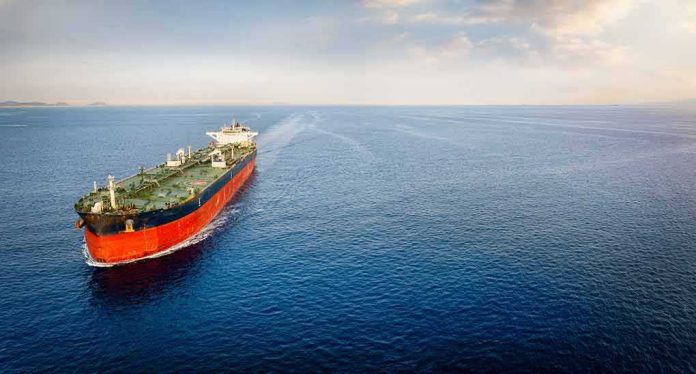
Traffic through the Strait of Hormuz did not collapse into the apocalyptic shutdown many television panels hinted at. Maritime tracking data show 55 commodity vessels crossed between May 11 and 17, right back around the weekly average recorded since the latest Middle East conflict began.[2] The shocking part sits in the comparison: just 19 vessels made the trip the previous week, the lowest level since the first United States–Israeli strikes on Iran in late February, when owners briefly treated the Strait like a live minefield.[2]
That rebound matters because this narrow waterway carries roughly a quarter of global seaborne oil trade, plus large volumes of liquefied gas and fertilizers.[6] If any place on earth could justify lasting panic, it is this funnel between Iran and Oman. Yet tanker operators, charterers, and insurers looked at missile headlines, recalculated risk premiums, and then put ships back into the lane as soon as they believed vessels could transit under some predictable set of rules, even if those rules came from dueling gunboats.[2][6]
Missiles, Escorts, And A Contest For Control Of The Chokepoint
The “rules” turned violent when United States Central Command said Iranian forces fired cruise missiles and drones at United States–flagged merchant ships and United States Navy vessels during a transit, an attack American warships reportedly intercepted.[1][6] Trump answered by rolling out an escort plan branded “Project Freedom,” presenting it as a mission to guide commercial shipping safely through Hormuz and keep the Strait open for everyone willing to sail under American protection.[1] From a conservative security lens, that is classic deterrence: show the flag, escort the tankers, and make clear you will shoot back.
Iran framed the same events as something else entirely. Officials said the Strait was open but that passage “should be coordinated with the Iranian military side,” adding that it remained open to all “except Iran’s adversaries.”[2] A new Persian Gulf Strait Authority was announced in state-linked media, paired with talk of ships applying for permits detailing ownership, cargo, and crew.[5] That looks less like harmless traffic control and more like a bid to turn a global commons into a tollbooth operated at gunpoint, especially when paired with actual missile launches.
Why Tankers Keep Sailing Even When Shots Are Fired
Analysts at Harvard’s Belfer Center have long assessed that Iran has the tools to seriously harass the Strait of Hormuz for weeks using mines, anti-ship missiles, and swarms of small boats, but not the ability to hold it closed against a sustained United States and allied campaign.[4] That asymmetry creates a strange equilibrium: Iran can make everyone nervous and drive up insurance rates; the United States can, if pushed, reopen the Strait at the cost of a heavy air and naval campaign.[4] Shipowners read that balance sheet and conclude that short bursts of danger are likely, total shutdowns far less so.
History backs them up. During the so-called Tanker War of the 1980s, Iran and Iraq launched hundreds of anti-ship attacks. Shipping volumes initially fell about a quarter and oil prices spiked, but traders adapted quickly. Iran actually discounted its oil to offset higher war-risk insurance, and the real global oil price declined over the decade.[4] Even at the peak of that conflict, no more than about two percent of ships in the Persian Gulf were successfully disrupted.[4] Markets learned that smoke and fire near Hormuz do not automatically mean empty gas stations in Ohio.
Threats, Law, And The Battle For The Narrative
The 2026 crisis adds something new: a rolling information war layered on top of the missile war. Trump’s very public threats to devastate Iranian assets if attacks continued produced a wave of commentary, some warning of escalation, some arguing that only blunt language gets Tehran’s attention. Iranian officials countered by labeling any strike on civilian infrastructure “war crimes and crimes against humanity,” casting American rhetoric as unlawful aggression rather than defense of navigation.[2] Each side tried to claim the moral high ground while maneuvering for practical control over the Strait.
Trump: "Iran should be scared."
Iran: "We are not even scared of dying. If you want another war, go ahead. We will get another chance to discipline America."
Read that again.
Not scared of dying. Eager to discipline America.
This is not a threat. This is a civilization that…
— Rishi Dev Arya (@RishiDevArya6) May 18, 2026
For Americans who care about energy prices, deterrence, and the rule of law, the conservative common-sense filter cuts through the spin. A country that fires missiles and drones at commercial traffic and then demands permits to let tankers pass is not safeguarding freedom of navigation; it is leveraging a chokepoint to extract political concessions.[1][5][6] At the same time, Washington owes citizens more than dramatic podium lines. The public should see clear evidence, legal rationale, and limits on any promised use of force, not just television-ready soundbites.
Sources:
[1] YouTube – Iran attacks U.S. ships in the Strait of Hormuz amid ‘Project …
[2] YouTube – Strait of Hormuz tensions deepen as Iran-US dispute …
[4] Web – Assessing the Iranian Threat to the Strait of Hormuz
[5] YouTube – Iran sets up new Strait of Hormuz managing body amid …
[6] Web – Iran: US Forces Fled After Strait of Hormuz Missile Attack