U.S. forces obliterated a narco-terrorist vessel in the Eastern Pacific, killing two while three clung to wreckage—exposing the raw edge of Trump’s war on drugs flooding American streets.
Story Snapshot
- U.S. military’s lethal strike on low-profile drug boat left three survivors; Coast Guard later confirmed two dead, one alive.
- Part of Operation Southern Spear, with 47 strikes killing 163 alleged traffickers by March 2026.
- Directed by President Trump, announced by Defense Secretary Pete Hegseth, executed by SOUTHCOM under Gen. Francis Donovan.
- Targets “narco-terrorists” like ELN in international waters to block drug flows into U.S.
- No U.S. casualties; sparks debate on legality versus border security imperatives.
Strike Details in the Eastern Pacific
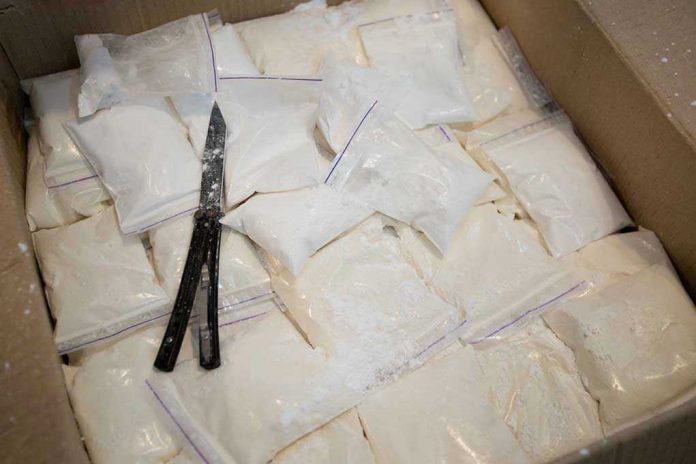
U.S. Southern Command struck a low-profile vessel on Thursday in known narco-trafficking routes off South America’s coast. Intelligence confirmed the boat, operated by designated terrorist organizations, carried drugs toward U.S. borders. The lethal kinetic action sank the craft. Three narco-terrorists survived initially, prompting U.S. Coast Guard search and rescue. No American forces suffered injuries. This marked another escalation in Pacific operations.
Operation Southern Spear Origins
President Trump launched Operation Southern Spear in September 2025 with a Navy airstrike on a Venezuelan boat in the Caribbean, killing 11. The campaign expanded to the Eastern Pacific in October, targeting groups like Colombia’s National Liberation Army and Venezuela’s Tren de Aragua. U.S. warships deployed mid-August to interdict vessels. By late 2025, strikes intensified amid the Iran war, framing drug runners as national security threats demanding decisive force.
Escalating Strike Timeline
Post-expansion, SOUTHCOM hit Pacific boats relentlessly: 21 October killed two off Colombia; 22 October took three lives; 27 October destroyed four boats, killing 14 with one Mexican-rescued survivor; 29 October claimed four; 4 November two; 9 November six across two vessels. The recent Thursday strike fit this pattern, aligning with reports of two deaths. Cumulative toll reached 163 by March 2026 across 47 operations on 48 boats.
Key Leaders Driving the Campaign
President Trump directs the policy as a border protection priority. Defense Secretary Pete Hegseth announces strikes on X, like the 27 October multi-boat action and recent Pacific hits. Gen. Francis Donovan leads SOUTHCOM executions, verifying intelligence on narco-operations. U.S. Coast Guard and Mexican Navy handle survivor rescues, coordinating in international waters. Targets link to ELN; U.S. acts unilaterally against these designated terrorists.
U.S. military kills 2 in another alleged drug boat strike in eastern Pacific #PacificOcean #Drugtrafficking #DODhttps://t.co/f9mXdomRfr
— Trieufamily (@TrieufamilyPhat) April 14, 2026
Impacts and Controversies
Short-term, strikes disrupt routes and deter traffickers, curbing U.S. drug influx. Long-term, they militarize anti-drug efforts, risking clashes with cartels. Affected parties include 163 dead traffickers and rescued survivors; coastal communities near Colombia and Mexico feel operational ripples. Economically, they aim to slash imports; politically, they rally domestic support for security while drawing international human rights scrutiny.
Clashing Perspectives on Legality
U.S. officials hail successes, citing confirmed intelligence against terrorists poisoning American communities. Common sense aligns with Trump’s approach: sovereign duty protects citizens from fentanyl floods killing thousands yearly. UN experts decry extrajudicial executions in international waters, questioning UN Charter compliance absent public evidence. Facts show consistent survivor counts and no civilian deaths; criticisms weaken against verified narco-threats and zero U.S. losses.