Boise just found a loophole to keep Pride symbolism on public property after Idaho banned non-official flags—raising fresh questions about who really sets the rules: the state, or the city.
Quick Take
- Idaho’s HB 561, signed March 31, 2026, bars most non-official flags on government buildings with fines up to $2,000 per day per flag.
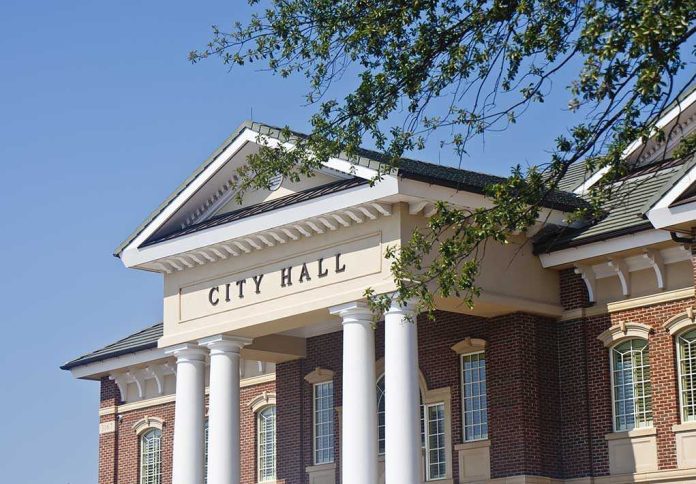
- Boise removed its Pride flag April 1, then returned a week later with rainbow-themed “art,” pole wraps, and accent lighting at City Hall.
- Mayor Lauren McLean said the city is “in full compliance,” arguing the new displays are not flags.
- State lawmakers wrote the updated law after Boise previously made the Pride flag an “official” city flag to sidestep an earlier restriction.
Idaho’s new flag law adds real enforcement pressure
Gov. Brad Little signed HB 561 on March 31, 2026, tightening Idaho’s restrictions on what can be flown on government buildings and attaching financial penalties. Reports say the law allows only a narrow set of flags—such as U.S., state, military, tribal, and Basque—while exposing agencies to fines that can reach $2,000 per day per flag. Boise City Hall took its Pride flags down on April 1 to avoid enforcement.
For conservatives, the key issue is not just the symbol but the principle: government property is supposed to represent all taxpayers, not serve as a rotating billboard for whichever political or cultural cause local leaders prefer. For liberals and LGBTQ residents, the removal landed as a message of exclusion. HB 561 sits at that crossroads, where state-level uniformity collides with a city’s desire to signal values through public display.
Boise’s answer: replace “flags” with Pride-themed “art”
About a week after the flags came down, Boise installed a new set of Pride-themed visuals at City Hall while insisting it remained inside the statute. Coverage described a rainbow-striped banner reading “Creating a city for everyone,” Pride-colored wraps around flagpoles, and rainbow accent lighting. City leaders framed the additions as art rather than flags, an approach meant to preserve the message without triggering the law’s specific flag prohibitions.
Mayor Lauren McLean publicly argued that the city complied because HB 561 “pertained to flags,” and Boise installed art that reflects the city’s values. Reports also described the palette as aligned with the Progress Pride look, broadening the symbolism beyond the original rainbow. As of April 8, 2026, outlets reported no fines or legal challenges tied to the new display, leaving open the question of how aggressively the state plans to test the distinction.
Why state lawmakers targeted Boise’s earlier workaround
The political backstory matters because it explains why Idaho’s 2026 update became more explicit. In 2025, Idaho passed a flag restriction that lacked real enforcement, and Boise responded by adopting the Pride flag as an “official” city flag—keeping it on the pole. Reports say state Rep. Ted Hill sponsored HB 561 in part to stop that maneuver by barring post-2023 city flags and tightening what qualifies for display.
A deeper fight over local control, culture, and trust in government
Boise’s move captures a broader pattern voters recognize nationwide: when governments can’t agree on core priorities like cost of living, infrastructure, and public safety, leaders often pour energy into symbolic disputes. Conservatives see a city using taxpayer-owned space to advance a contentious cultural message, then hunting for a loophole when voters’ representatives shut it down. Liberals see state power used to suppress a community’s visibility, then celebrate creative resistance.
Both sides can also recognize a more basic reality: the law’s effectiveness depends on consistent definitions and enforcement, and the public rarely gets clear answers. If “flag” becomes whatever a city says it is, state policy can be nullified by clever rebranding. If the state responds by tightening restrictions again, the cycle escalates and deepens cynicism—another example of government spending time on culture-war trench lines rather than measurable outcomes that help working families.
Sources:
A week after removing its Pride flags, Boise displays LGBTQ colors at city hall
Idaho said no Pride flags permitted. Boise said watch this
Idaho passed a law just to ban Boise from flying Pride flags — their response was surprising